
Photographing Conflict Damage at Preah Vihear Temple for the Australian Financial Review

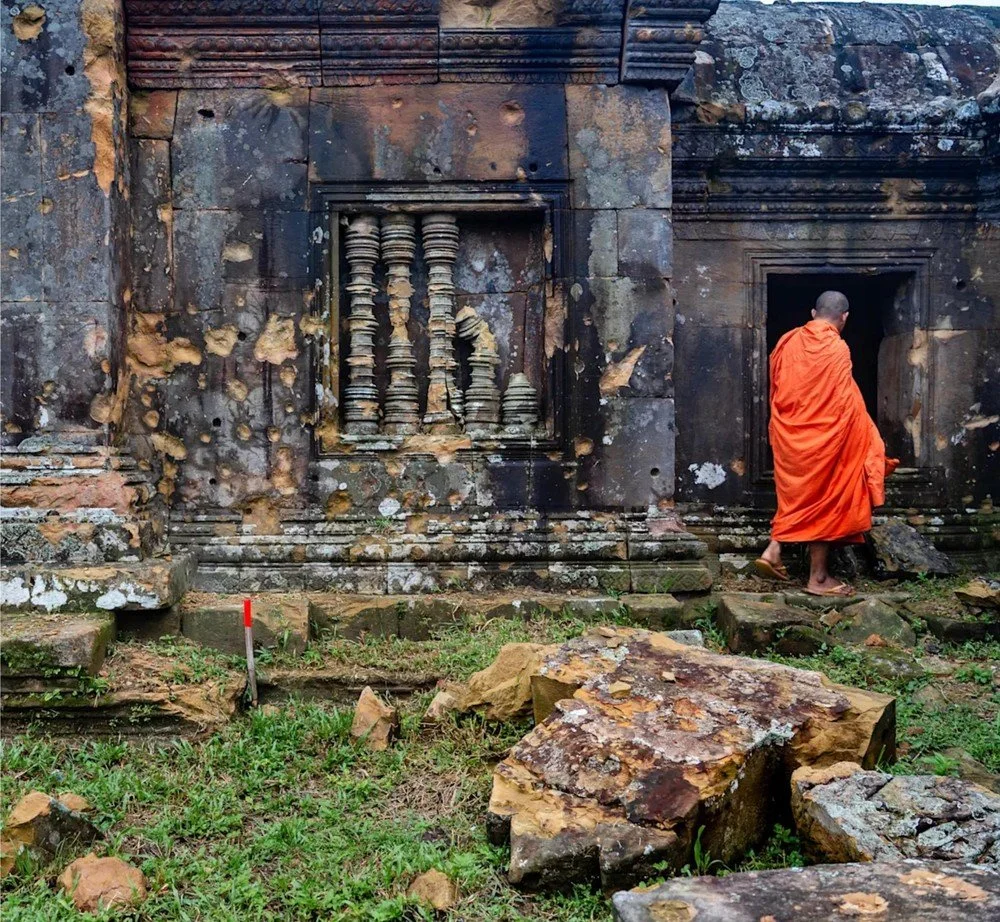
Abbot Sun Sang in the ruins of Wat Keo Sekha Kiri Svarak, the pagoda on the mountain at Preah Vihear. © George Jefferies
In mid-September I travelled to Preah Vihear temple in northern Cambodia as a photojournalist and video journalist, working alongside the journalist and author Nick Ray. The UNESCO World Heritage Site sits on a clifftop on Cambodia's border with Thailand and had been closed to visitors since the fighting in July and December 2025. Nick's story, illustrated with my photographs, ran in the Australian Financial Review's Weekend Fin magazine, online on 15 October and in print on 17 October 2026.
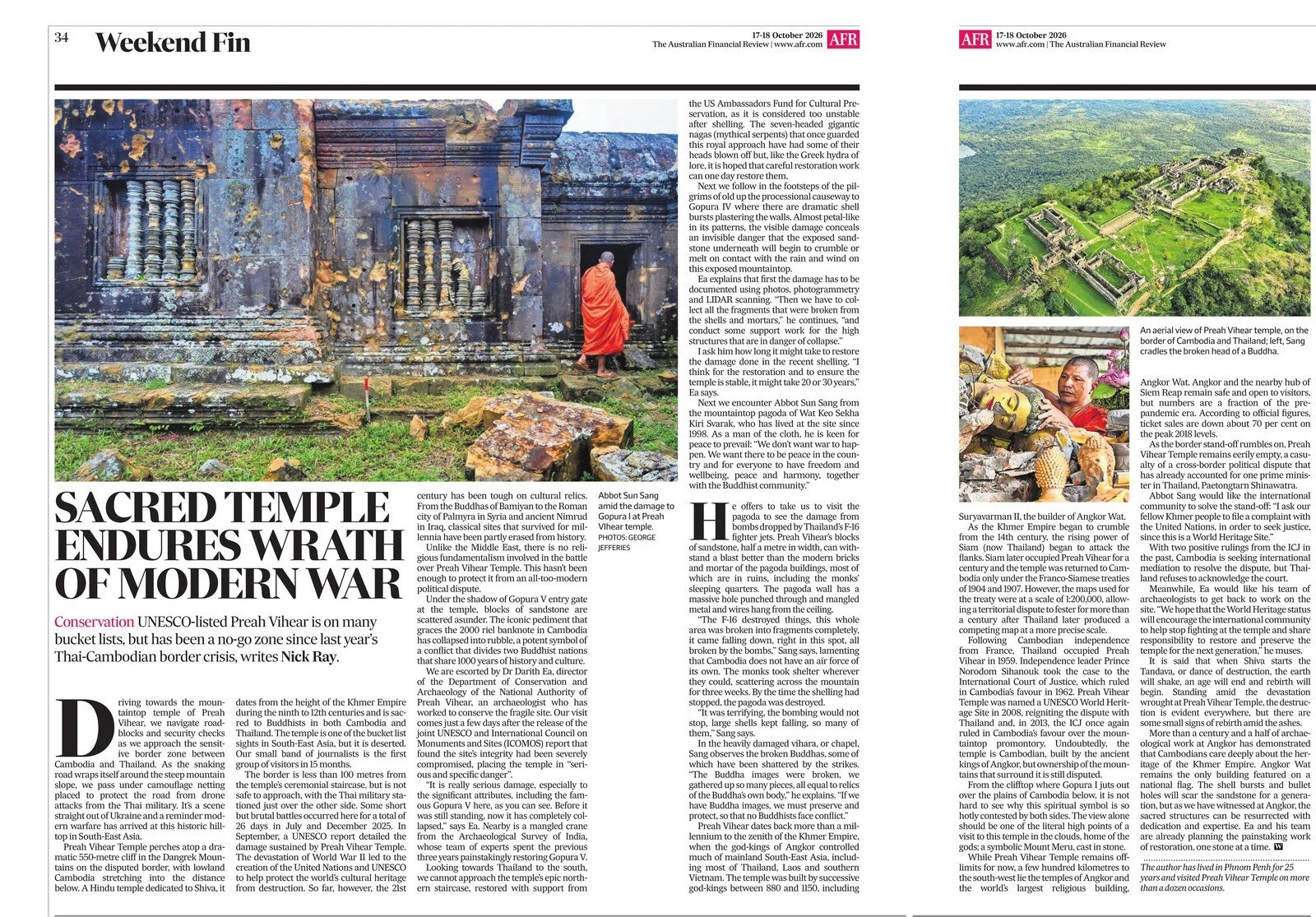
The print edition of Weekend Fin, 17 October 2026.
How the trip came together
Nick was heading to the northwest of Cambodia to research his section of a new Lonely Planet book, and Preah Vihear was on his list. As soon as he mentioned it, I asked to come along. I'd wanted to see the temple and the damage for myself since the fighting last year. We went on spec, with no commission in place, planning to shoot the story first and then work together to sell it.
Nick organised the access through the Ministry of Culture and Fine Arts, whose minister, H.E. Dr Phoeurng Sackona, I'd interviewed for the feature documentary Loot. The ministry pointed us to Dr Darith Ea, director of the Department of Conservation and Archaeology at the National Authority for Preah Vihear. Nick and Darith go back to 2000, when Lara Croft: Tomb Raider filmed at the Angkor temples and Nick worked on the production as a line producer. The authority wanted international attention on what had happened to the temple, and they made us welcome from the start.
Battambang to Sra Em
We spent the first night in Battambang, then drove on to Tbeng Meanchey, the provincial capital of Preah Vihear, where Nick looked at hotels for the guidebook. From there we continued to Sra Em, the closest town to the temple. That evening we met Darith and a couple of his staff to introduce ourselves and go over what we'd be allowed to do and what the situation was on the mountain. We had dinner with them afterwards. The mood was sombre.
We set off at about 7.30 the next morning and wound our way up the mountain road. We'd been told to expect a couple of hours at the top, and we ended up spending about four.
The abbot and the pagoda
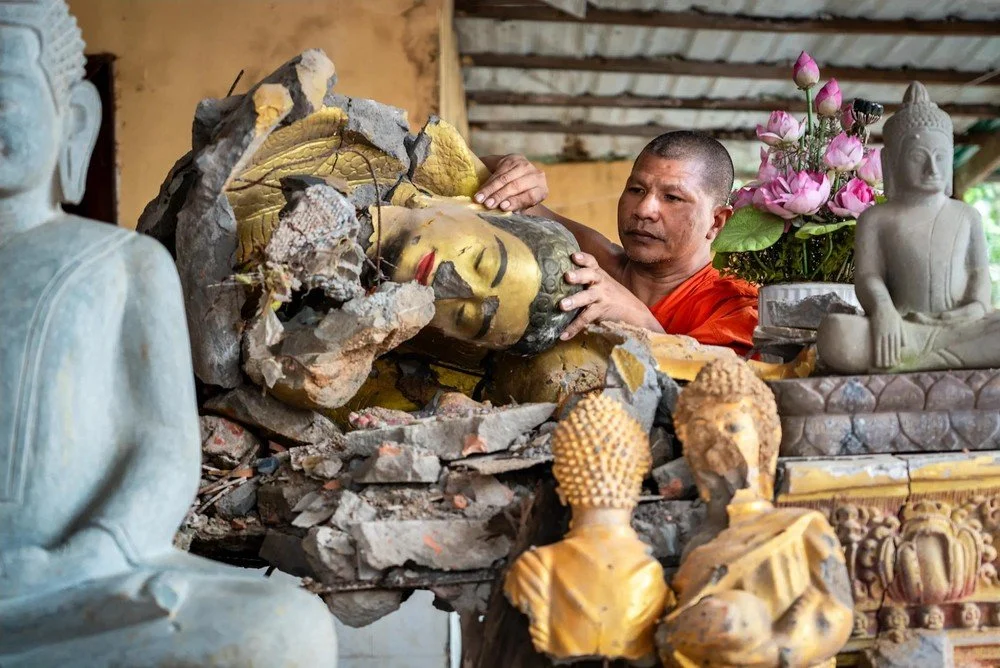
Our first stop on the way up was Wat Keo Sekha Kiri Svarak, the modern pagoda on the mountain. Abbot Sun Sang has lived at Preah Vihear since 1998. He took us around the pagoda, where most of the buildings are in ruins, including the monks' sleeping quarters. He has gathered the broken Buddha images and fragments together and is keeping them as evidence of what happened.
“The Buddha images were broken, we gathered up so many pieces, all equal to relics of the Buddha's own body,” he said. “We don't want war to happen. We want there to be peace in the country and for everyone to have freedom and wellbeing, peace and harmony, together with the Buddhist community.”
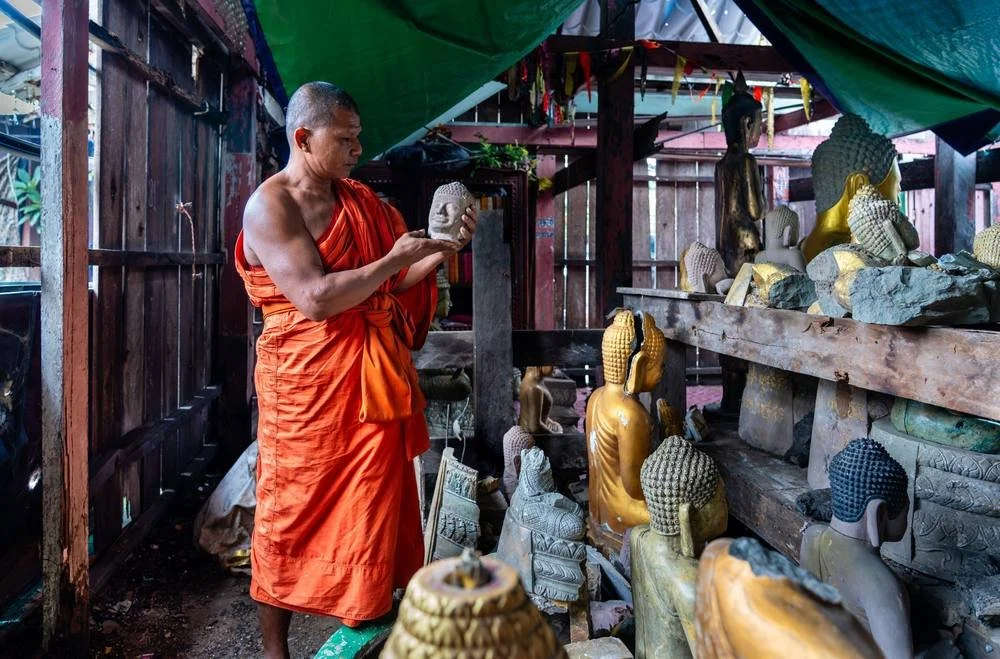
Abbot Sun Sang with a broken Buddha head. He has gathered the damaged statues together at the pagoda. © George Jefferies
The damage to the temple
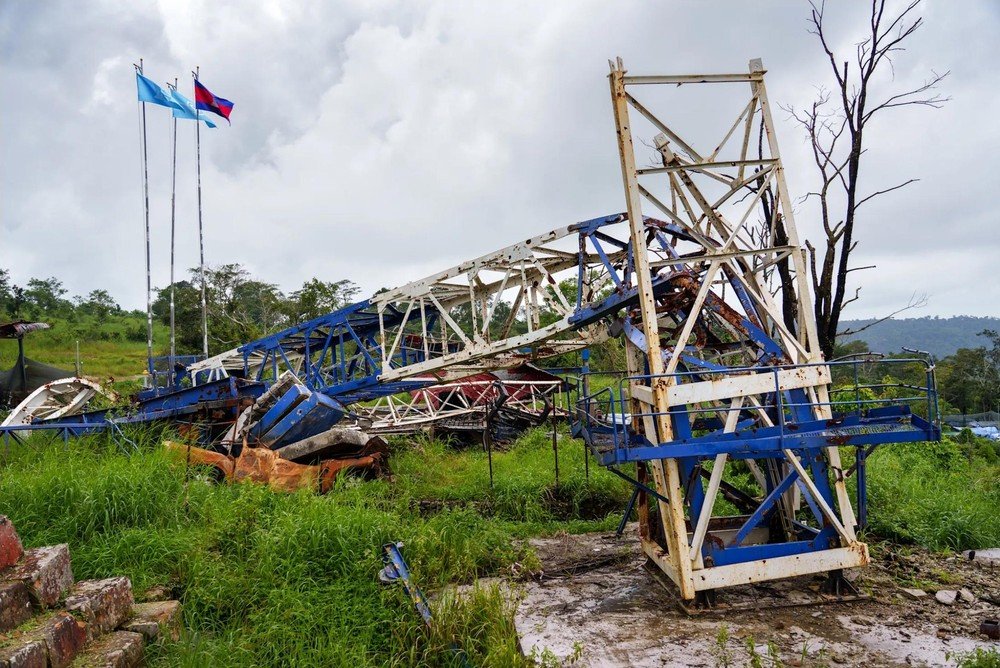
From the pagoda we went up to the temple itself. Preah Vihear was built by successive Angkorian kings between the ninth and 12th centuries, and runs for around 800 metres along the slope to the cliff edge through five gopuras, or gateways. Gopura V, the gateway that appears on the 2,000 riel banknote, is now a pile of sandstone blocks. A crumpled crane belonging to the Archaeological Survey of India lies beside it. Their team had spent the previous three years restoring the gateway.
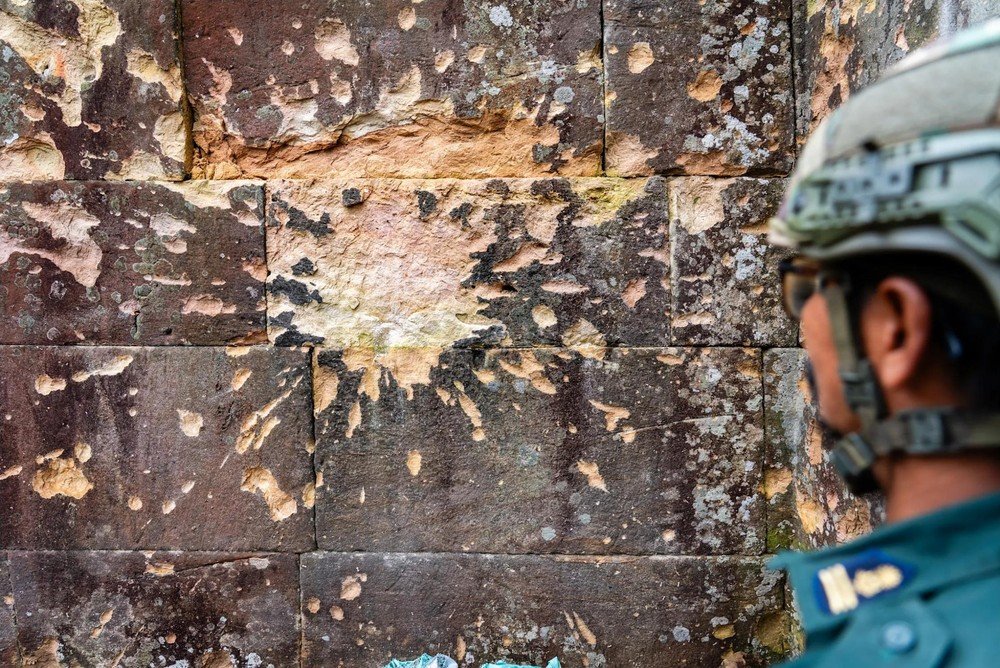
“It is really serious damage, especially to the significant attributes, including the famous Gopura V here, as you can see,” Darith said. “Before it was still standing, now it has completely collapsed.” His team has documented 562 separate points of damage across the site.
After an assessment by UNESCO and the International Council on Monuments and Sites (ICOMOS), the first jobs are documenting the damage with photography, photogrammetry and 3D scanning, collecting the broken fragments, and propping up the structures at risk of collapse. “I think the restoration of the temple will take 20 or 30 years,” Darith said.
Working around the restrictions
Parts of the site nearest the border, including the northern staircase, were off limits. The Cambodian Mine Action Centre (CMAC) has been through the temple since the fighting and believes the mines and unexploded ordnance have been cleared, but the red warning signs are still up and we stuck to the paths and the main temple structures.
Shooting stills and video on the move
We didn't know how long we'd have at the top or exactly what we'd be allowed to film, so I kept the kit light, moved quickly and worked with available light throughout.
I shot stills on the Sony A7 IV with a Sony FE 24-105mm f/4 G, and used the same camera for handheld video with the Sony XLR-K3M adapter kit and its shotgun mic on the hot shoe. A second body, the Sony A7S III with a Tamron 17-28mm f/2.8, was on a gimbal with a Rode VideoMic for following Darith and the abbot as they walked us through the site. Sinat, one of Nick's guides, came up with us as an assistant and held the boom during the interviews. We'd worked together before on CNN's Nomad with Carlton McCoy.
From 500 frames to the magazine
I shot just under 500 frames over the morning. Afterwards the magazine asked to see what we had, and we sent around 25 selects. Once they'd seen the photos, they asked Nick to write the piece. I delivered the final selection as full-size JPEGs and DNG raw files.
The online version carries six of my photographs, and the print edition opened with the abbot at Gopura I across the top of page 34, with a second frame of him holding a broken Buddha head on the facing page.
I also shot video throughout the day, including the interviews with Darith and the abbot. The stills and footage from Preah Vihear are available to license for editorial and broadcast use. You can read Nick's full story on the AFR website.
Back down the mountain
Four hours wasn't long, but it was enough to see the scale of the damage and to hear from the people looking after the temple. Darith and his team are ready to start the long work of restoration as soon as the situation allows. For more on covering the border dispute, see my post on filming CNA Insider's documentary on the Thailand-Cambodia border.
For licensing, commissions and collaborations across Cambodia and Southeast Asia, get in touch. You can see more of my work as a photographer in Cambodia and as a video journalist.