
Flying Drones in Cambodia: Permissions, Experience and What You Need to Know
Drone showreel, aerial videography across Cambodia
I've been working as a drone operator in Cambodia since shortly after DJI launched the original Phantom in 2013. Since then I've flown the Phantom 2, 3, 4 and 4 Pro, the Mavic Pro, Mavic Pro 2, Mini 3 Pro, and now the DJI Air 3. I've used drones on productions ranging from NGO field work and corporate videos to broadcast documentary and feature film. The progress in that time has been remarkable, with the introduction of dual lenses, omnidirectional obstacle sensing, extended battery life, and stabilisation that makes aerial footage possible in conditions where earlier models simply couldn't fly.
This post covers the two locations where you'll definitely be asked for permission, Phnom Penh and the Angkor Archaeological Park, along with some notes on indoor flying, drone photography, and some highlights of my drone flying in Cambodia.
Flying in Phnom Penh
For television and documentary productions, the permissions process in Phnom Penh is a two-stage process. You apply first to the Ministry of Information, which processes the permit. You then take that letter to City Hall, where they countersign and confirm that you have approval to fly within the capital. If you're making a feature film, the Ministry of Culture and Fine Arts is the relevant authority.
When I was flying for CNN's Nomad with Carlton McCoy, the local fixer gave me a copy of the permission letter, which was a good idea. Every time I took off, a security guard arrived and asked to see the permission. You will be asked to show your paperwork when openly flying in central Phnom Penh, so make sure you have it.
People have been detained for flying in restricted areas, and some incidents are well known in the production community here. For professional work in Phnom Penh, obtaining permission before you fly is not optional.
At the time of writing, there is a blanket ban on drone flights across Cambodia as a result of the Thailand-Cambodia border situation. Permissions are still being granted for the right projects, but this is worth factoring into your planning if you're scheduling a drone shoot in the near future.
Flying at the Angkor Archaeological Park
Angkor operates through the Apsara Authority, the body responsible for managing the archaeological park. You apply in writing and the process typically takes between two weeks and a month. The Apsara Authority will confirm whether permission is granted and advise on the fee, which is set case by case rather than at a fixed rate.
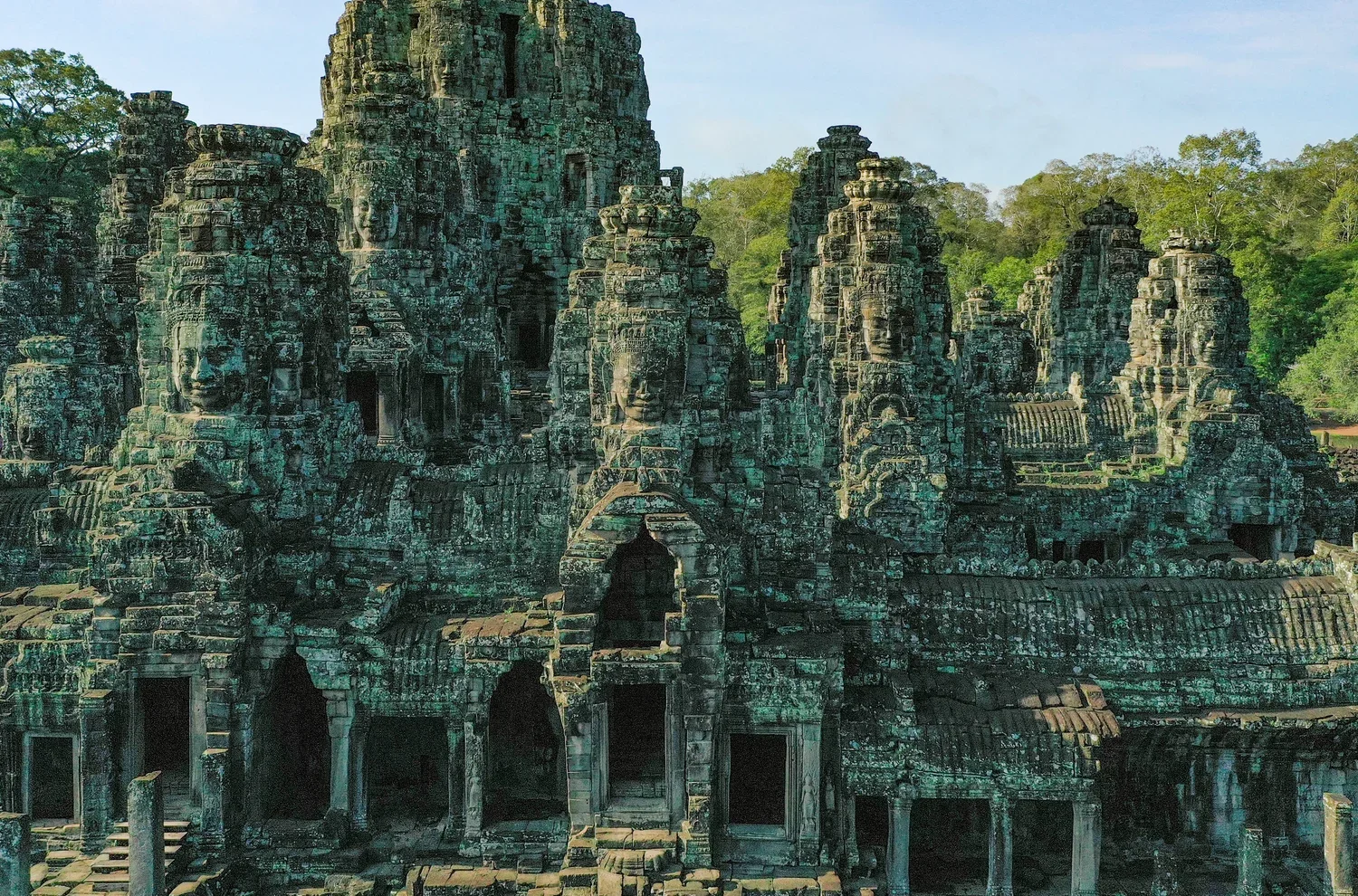
I've been lucky enough to fly my drone at the temples twice. The first was for Taste of Cambodia, a travel series for the Cambodia Ministry of Tourism produced with Hanuman Films, where I had a three-day permit covering Angkor Wat, Angkor Thom and Ta Prohm, the temple featured in Tomb Raider. The second was for CNN's Nomad with Carlton McCoy, shooting at Angkor Wat.
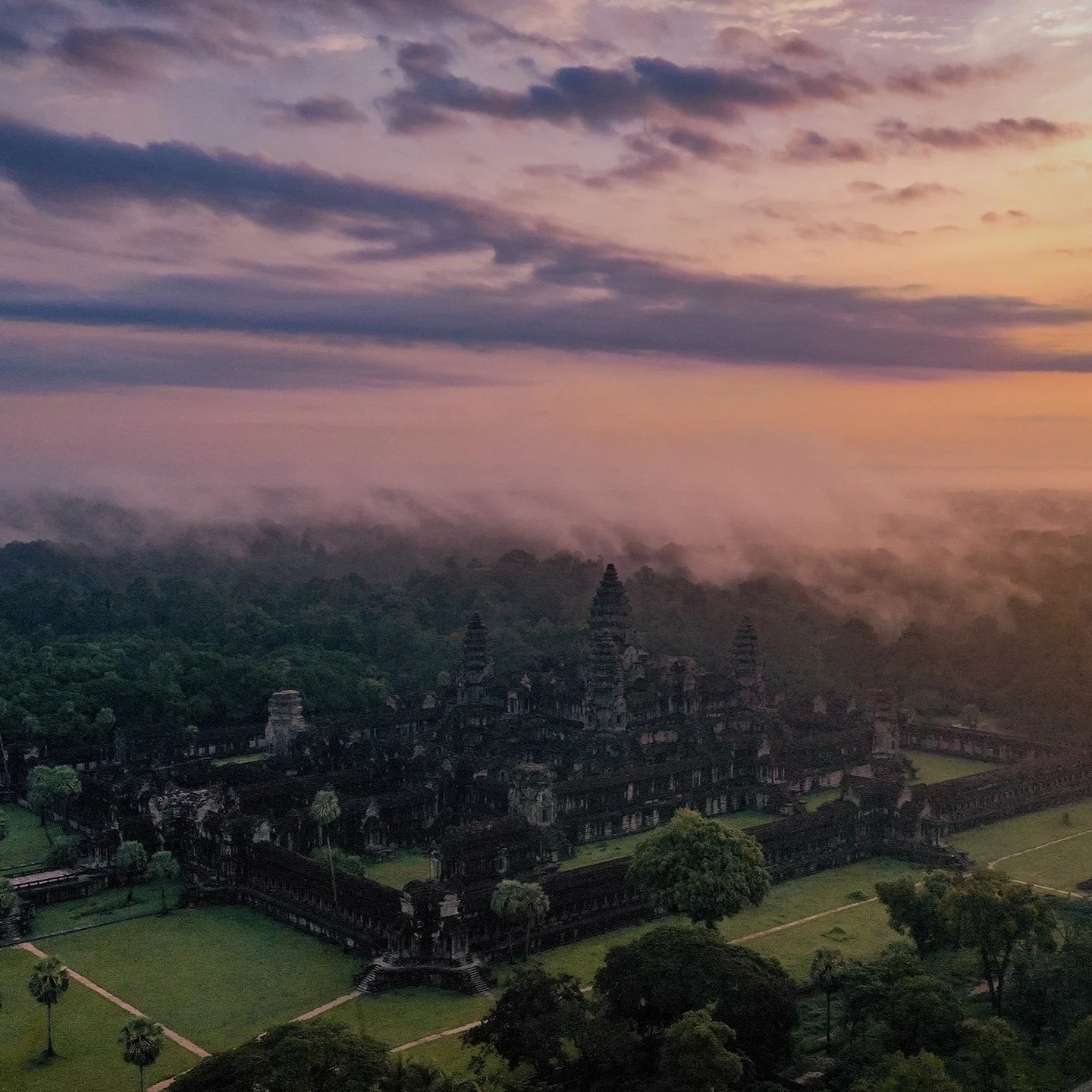
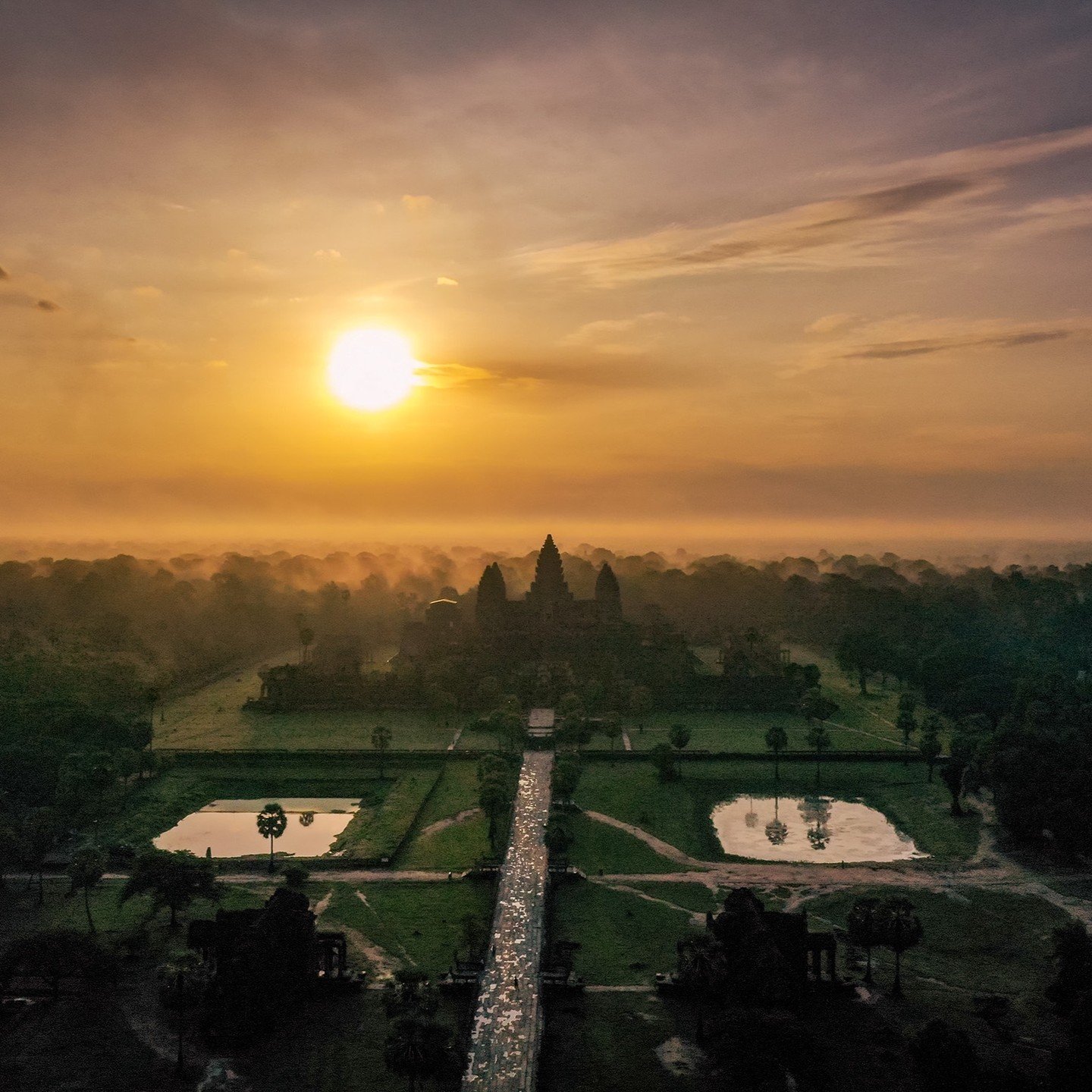
I was up before sunrise on the first two mornings of the Taste of Cambodia shoot at Angkor Wat, waiting for light that never came through the cloud. On the third morning it had rained overnight and, as the sun rose, mist lifted from the stone path leading up to the temple and the surrounding jungle. The footage from that morning made up for the earlier disappointments, and it's the kind of image that's only available if you have the right permissions and the patience to wait for the conditions to arrive.
Indoor Drone Work
Part of the drone work I do has been flying inside buildings, which is a different discipline from outdoor flying and one that demands a drone with reliable obstacle sensing.
For a corporate film for Endo Lighting, I flew inside AEON 3 Mall in Phnom Penh to capture their lighting installation. Flying up through the full height of the central atrium and along the skywalk, a key part of the design they wanted to show, gave the client footage that couldn't have been achieved any other way. You can see the video here.
For a video produced with Pixel Peers for the ILO's Better Factories project, I flew inside a garment factory in Kandal Province on the outskirts of Phnom Penh, documenting the manufacturing environment as part of their Better Factories programme.
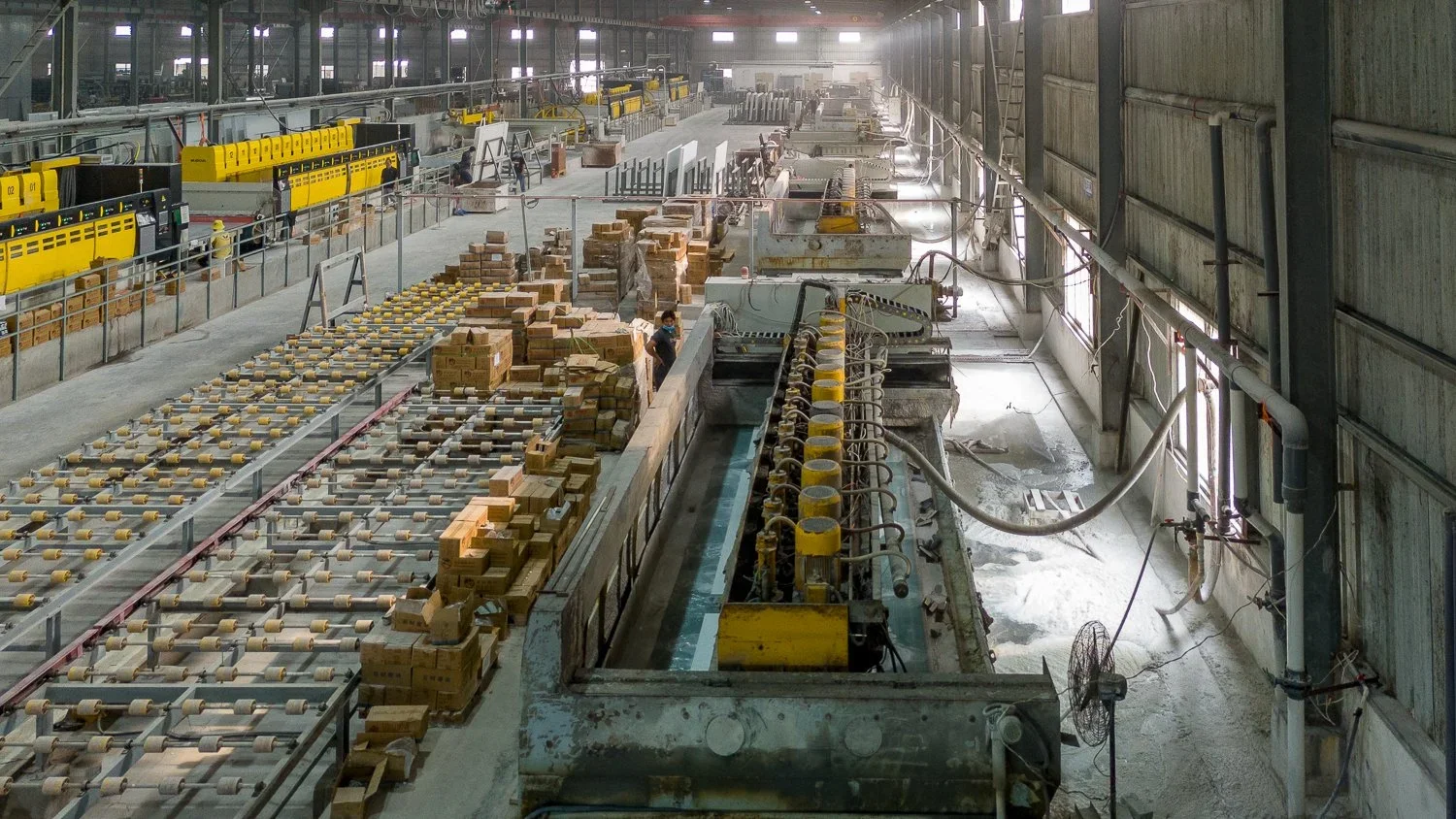
I also flew inside Cambodia Zulite Stone's quartz manufacturing facility for a corporate film delivered for exhibition at a trade show in New York. The DJI Air 3's omnidirectional obstacle sensing makes it well suited to indoor work of this kind.
On a number of shoots, drone photography has been delivered alongside the video. The Air 3 and many other DJI drones make switching between modes straightforward. You press the left-hand shoulder button and it switches between photography and video. Once the settings for both are configured, it's easy to switch at the click of a button, and then another click either takes a photo or starts recording. Stills and video can be captured in the same session without significantly disrupting the shooting workflow. Both Endo Lighting and Cambodia Zulite Stone received drone photography deliverables alongside their films. Drone stills are something I can offer alongside videography on most shoots.
Flying Across Cambodia
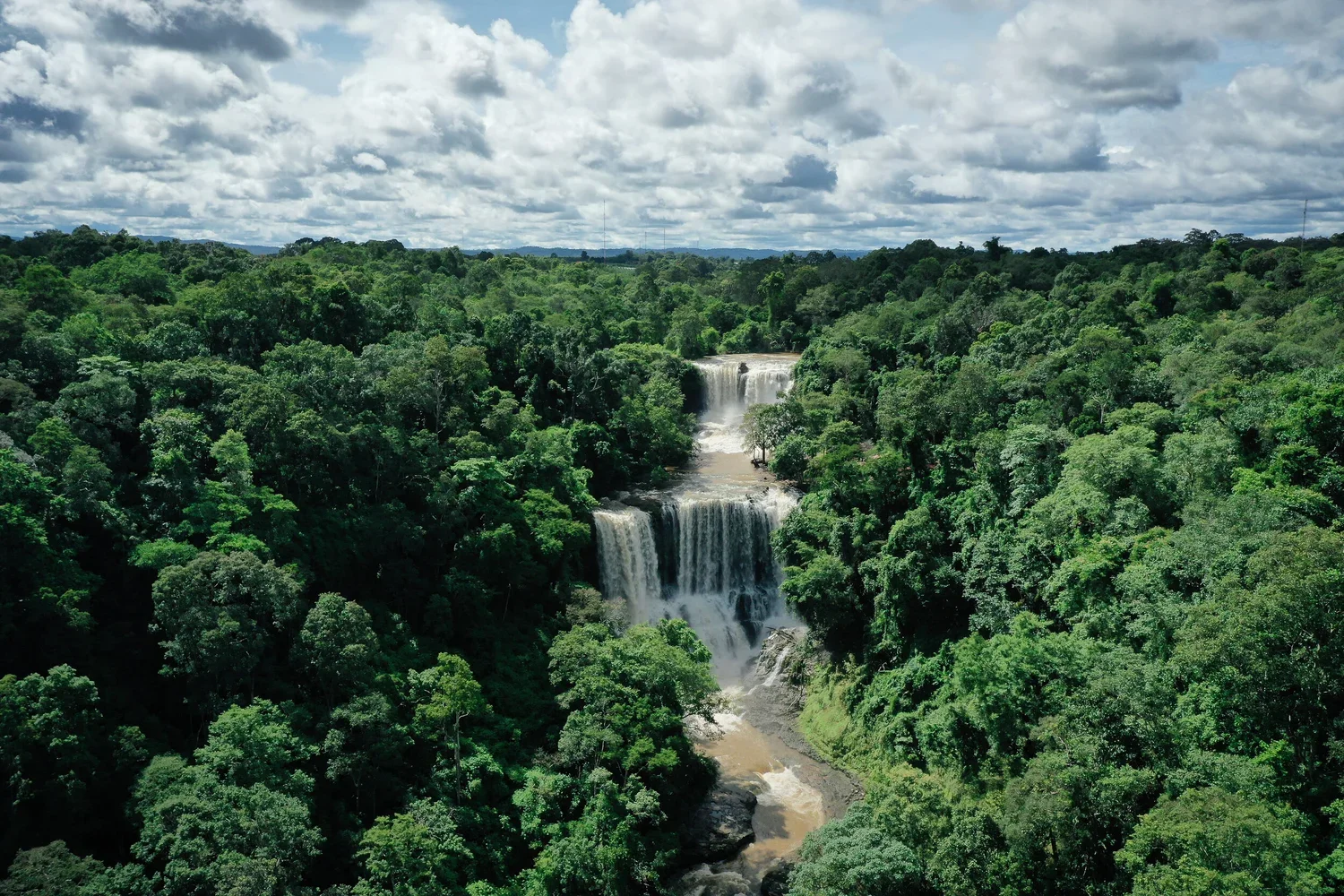
Across Cambodia as well as Phnom Penh and Angkor, I've flown for a wide range of productions. Locations include Kampot and Kep on the coast, the highlands of Mondulkiri, Kratie, Stung Treng, Battambang and Kandal Province. Outside the capital and the archaeological park, enforcement is lighter and I've never been stopped when flying recreationally, though technically a local authority approval from the relevant sangkat is required alongside the Ministry of Information permit for professional productions.
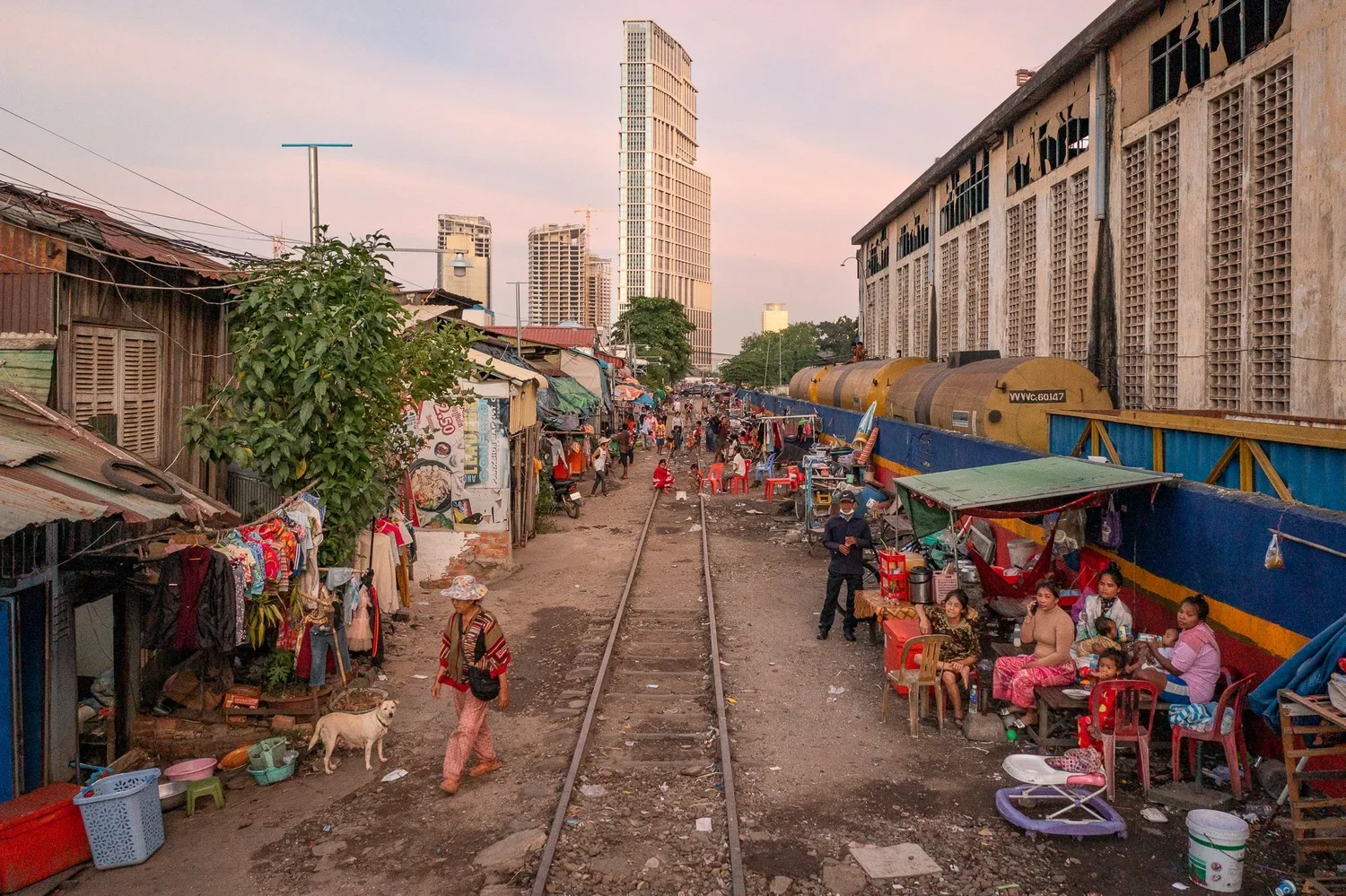
Productions involving significant drone work include a 46-minute documentary for CNA Insider on the Funan Techo Canal, where I flew over the Mekong River, Battambang's rice paddies and the Phnom Penh Autonomous Port, and the Taste of Cambodia series for the Ministry of Tourism. For the CNN shoot I flew Central Market, Wat Phnom, Vattanac Tower, the CBD and the Angkor temples. For Wild Frontiers, one of the UK's leading adventure travel companies, I flew across India, Ukraine and Moldova. You can see a selection of that aerial work in my drone reel for Khreativa.
Cambodia as a Production Destination
The Cambodia Tourism Board recently launched a Location Scouting Programme designed to support international film, television, documentary and commercial productions. The programme covers up to five days of on-ground expenses during location scouting, including accommodation, local transport, fixer or guide services, and entry fees for national parks and heritage sites. Flights are not covered, but it's an encouraging development that reflects a genuine effort by the Cambodian government to attract international productions to the country.
Kit
My current drone is the DJI Air 3, with 28mm and 70mm lenses and omnidirectional obstacle sensing, suitable for both indoor and outdoor work. Additional drones are available to hire for productions requiring different specifications. Full production kit, including lighting, sound and grip, is available alongside drone services.
You can see more of my drone work on the drone operator page, and further examples across the corporateand documentary portfolio pages.
If you have questions about flying drones in Cambodia, whether for a production you're planning or just to understand the permissions process, feel free to get in touch. Based in Phnom Penh and available for assignments across Southeast Asia.
Working as Director of Photography on a CNA Insider Documentary About the Funan Techo Canal
At the end of last year I was brought in as director of photography on a 46-minute documentary for CNA Insider, the long-form current affairs strand of Channel NewsAsia. The film, Cambodia’s Mega Canal Has Vietnam Worried: What Does It Mean for the Mekong?, examines the Funan Techo Canal, a 180km waterway that will connect the Mekong River to the Gulf of Thailand, and the regional tensions it has stirred, particularly with Vietnam. It was produced by Loy Kheng Wee and executive produced by Daniel Heng, both of whom were in the field with me throughout the shoot. Daniel is an experienced hand with a deep knowledge of Southeast Asia and the Insight series.
It was a five-day shoot across multiple locations in Cambodia: Phnom Penh, the groundbreaking site of where the canal will be built, Battambang, and the Phnom Penh Autonomous Port. Over the course of the week we filmed more than ten interviews, and during interviews I operated two cameras to give the editor a choice of angles.
46-minute CNA Insider documentary on the Funan Techo Canal, Cambodia, director of photography: George Jefferies
The Technical Setup
It was a multicam shoot. During interviews, I worked with a Sony FX6 and Sony A7S III, with the FX6 as the wider master and the A7S III as the closer camera. I also mounted the A7S III on a gimbal, giving different shooting options at all points and allowing me to move quickly and efficiently between handheld, gimbal, and tripod as each situation required. Sound was recorded both on a boom mic and a concealed lav mic, which gave us clean options in post regardless of the environment.
Drone work was also part of the brief. The local fixer obtained the necessary permissions to fly in Phnom Penh, and I flew the DJI Air 3 across several locations: the Mekong River, the Cambodian-Japanese friendship bridge crossing the Tonle Sap, rice paddies and a rice processing facility in Battambang, the Koh Pich area of Phnom Penh, and the Phnom Penh Autonomous Port where cargo boats currently make the journey down the Mekong through Vietnam. That footage was particularly relevant to the story, as those are the boats that would eventually use the canal rather than the Vietnamese route.
Interviews and Locations
The range of interview subjects gave the film its shape. In Phnom Penh we filmed with Chea Thyrith, spokesperson for the CPP, along with a range of experts offering analysis of the canal’s economic and geopolitical implications. At the groundbreaking site we spoke with a number of local residents living in the path of the canal. They knew little about what relocation would mean for them, as compensation, timing, and next steps were all still unclear, largely because the project itself had yet to move beyond its early stages. At the Port Authority building we interviewed a representative about the commercial case for the canal. In Battambang, we filmed with a rice factory owner who currently exports through Cambodia having previously relied on Vietnamese ports, and shot in the rice paddies where the crop is grown.
Lighting and operating across that many locations over five days, with two cameras, is a logistical undertaking. Each location brings its own challenges: ambient light direction, background management, the fast pace at which a documentary crew moves. Getting consistent, broadcast-quality results across all of them is the job.
The Story Itself
The Funan Techo Canal is a project that raises significant questions. Cambodia argues the canal will reduce its reliance on Vietnamese ports, through which roughly a third of its global cargo currently passes. Vietnam, meanwhile, is concerned about the canal’s potential to divert water flows from the Mekong Delta, a river system already under pressure from upstream dams and climate change. There are also questions about whether the waterway could serve Chinese military purposes, though experts note it will not be deep enough to accommodate naval vessels.
When we were shooting, there was genuine uncertainty about the project’s timeline and funding. People we spoke to were largely supportive of the idea, but specifics were hard to come by. Since filming, a financing deal between Cambodia and China has been finalised, which gives the project more concrete footing, though whether it meets its 2028 completion target remains to be seen.
Working with the Production Team
It was good to work alongside Daniel Heng, whose knowledge of the region showed throughout the shoot. I also worked with producer Loy Kheng Wee, for whom this was her first shoot in the field as a producer. I hope it was a useful experience and that she has gone on to make many more interesting documentaries.
CNA Insider has been one of the more consistent commissioners of serious, long-form journalism in Southeast Asia. Working on a documentary of this scale and complexity, covering a story with genuine regional significance, was a good addition to the slate.
Working on something similar? Drop me a line, I’d be happy to discuss how I can help.
Working as a Video Journalist for CNA Insider: The Thailand–Cambodia Border Crisis
It isn’t every day that a shoot gets cancelled on a Saturday and replaced with something more significant by Monday. That’s what happened in early July when I was engaged as a video journalist and camera operator for CNA Insider’s Behind The Thailand–Cambodia Feud That Could Topple The Thai Government.
The original assignment was a shoot on the Funan Techno Canal. When the Thailand–Cambodia border dispute escalated and the border closed, the episode producer called to say that they had enough material to focus entirely on the border story and the political fallout from the leaked phone call between Thai Prime Minister Paetongtarn Shinawatra and Cambodia’s elder statesman Hun Sen. The canal documentary was put on hold — it became an entirely separate episode, which I shot a couple of months later. Rather than wait to be reassigned or stand down, I proposed that the border story would be significantly stronger with footage and perspective from the Cambodian side. A piece focused solely on Thai political implications would only tell half the story. She agreed, and over the weekend we developed the editorial approach together. By Monday we had a clear angle and a shooting plan. By Tuesday I was at the Poipet border crossing with my camera.
CNA Insider’s documentary on the Thailand–Cambodia border dispute, filmed on location in Poipet and Phnom Penh
Identifying the Story, Then Telling It
The editorial contribution on this shoot went beyond operating the camera. Identifying that the Cambodian perspective was missing, making the case for it, shaping who we needed to speak to and what the footage needed to establish — that groundwork happened before a single frame was shot. It’s the kind of work that sits at the heart of what a video journalist does, and it’s what made the difference between a one-sided political explainer and a genuinely balanced documentary.
Before heading to Poipet on the Tuesday, I sat down in Phnom Penh with Virak Ou, head of the Future Forum think tank, for a wide-ranging on-camera interview about the historical and political context of the dispute. Getting a credible, English-speaking Cambodian analyst on record gave the episode the intellectual anchor it needed from the Cambodian side. I handled the full production setup for the interview: a multicam shoot using the Sony FX6 as the primary camera and the Sony A7S III on a secondary angle, with lighting, a boom mic, and a lavalier. Two clean angles gave the editor flexibility in a long-form format.
Getting There Fast Mattered
Timing on this story was critical. When I arrived at Poipet, workers were still being allowed to cross from Thailand into Cambodia, and there were people waiting at the border hoping to get through. A couple of days later, the authorities stopped people from waiting at the crossing altogether. The human story I filmed would have been considerably harder to tell even 48 hours later.
Being based in Phnom Penh, able to move quickly, and ready to operate independently across both the editorial and technical sides of a shoot meant we didn’t miss that window. Fast-turnaround, self-sufficient field journalism in complex or fast-moving situations is something I’ve done across a number of assignments in Cambodia and the wider region — you can see more examples in my work for the EU Delegation and on the Tonle Sap.
Filming the Human Cost at Poipet
The Poipet border crossing is one of the busiest land crossings in Southeast Asia. Thousands of Cambodian workers cross daily into Thailand where they work in markets, restaurants, and construction. The border closure immediately took away their work on the other side.
We interviewed workers who had just returned from Thailand and were trying to make sense of what came next. I also identified and filmed a hotel owner in Poipet whose business was impacted by the border closure. With cross-border visitors gone and trade frozen, she described the situation as serious — accounting for around 70 to 80 percent of her income — and spoke plainly about what starting over would mean for her and her children.
On the ground, the border guards and police were professional and friendly, and people were being treated with respect on both sides. But there was an underlying worry that was hard to miss. These were people who had built their working lives around this crossing, and overnight that had been taken away. You felt it in the conversations, in the groups of workers sitting and waiting, not entirely sure what to do next.
One of the most quietly telling details we filmed were the children. While workers were blocked and trade had stopped, the authorities were still allowing children to cross the border to attend school on the other side. Watching kids pass through a checkpoint closed to adults captured something about the human cost of the dispute that no commentary could.
A Cambodian Perspective on the Dispute
Virak Ou was direct about how Cambodia reads its position in the region. “Cambodia has been the victim of two larger, more successful neighbors,” he said. “On the east we have Vietnam, on the west we have Thailand. Cambodia still feels that we have been looked down upon as a backward [country] and we are going to stand up if we feel we are being attacked.”
He was equally measured about the risks of escalation. “It’s important to isolate these issues,” he said. “We need to ensure that we keep it at the political level, as a country to country issue to be resolved through diplomatic means. No benefits to ratchet up the tensions… when it affects the workers and the people from both sides.”
What the Episode Covers
The 46-minute documentary, which has now been viewed over 750,000 times on YouTube, focuses primarily on the Thai political crisis triggered by the leaked call. Prime Minister Paetongtarn’s deferential tone toward Hun Sen and her apparent disparagement of a senior Thai military commander created a firestorm of public anger, with tens of thousands taking to the streets in Bangkok demanding her resignation. The Constitutional Court subsequently suspended her from her duties while investigating the matter.
The footage from Cambodia provides the grounding for what the border dispute actually means on the ground, beyond the political theatre in Bangkok. It gives the episode balance and a human dimension that would have been missing from a story reported entirely from the Thai side — which was the whole point of proposing it.
A Strong Piece of Work, Turned Around Fast
CNA Insider is one of Asia’s most-watched current affairs programmes, and the Insight format allows for the depth that straight news rarely affords. Working across the editorial and camera roles on this one — proposing the angle, planning the shoots, conducting the Poipet filming, and delivering the Phnom Penh interview — was exactly the kind of independent, story-led video journalism I find most satisfying.
The contract was signed on the Monday. Filming was wrapped and the footage ready for delivery within three days. For this kind of assignment — reactive, location-based, editorially led — that turnaround reflects what’s possible when you have someone already on the ground who knows the territory and can work independently from day one.
CNA were happy with both the footage and the approach. The episode is well worth watching in full for anyone following the current situation in Thailand. You can find it on the CNA Insider YouTube channel.
Working on something in Cambodia or Southeast Asia that needs an experienced video journalist on the ground? Drop me a line — I’d be happy to discuss how I can help.
On location in Stung Treng – Filming a case study for UNICEF’s Generation Future Programme
It’s always good to get out of Phnom Penh on assignment and working as an NGO videographer on an assignment for UNICEF was no exception.
I’d made a video case study about Panha just as she started started a role as a team leader as part of the Code for Girls project.
It was always the plan to make a follow up video of Panha to see the progress she had made over the
Panha spoke about the new skills she had learnt. ‘Now, I can use code in my designs
to make all kinds of models,’ she said.
We also interviewed Lida, Panha’s IT teacher. She spoke about the progress Panha had made.
‘It makes me very happy to see Panha undergoing such a positive transformation. She has gone from a girl with basic typing skills to a girl who is confident in writing code,’ she said.
Panha also spoke about the training she had provided to her team members.
‘Over the past 6 months, I have trained my team members in STEM subjects. We’ve learned about using a 3D printer and coding,’ she said.
Chaily, one of Panha’s team members was very positive about the training Panha has given her.
‘Panha has helped to improve my drawing skills, and she’s improved my leadership
and teamworking skills,’ she said.
Panha has had to overcome difficulties to provide the best training she can.
‘Even though I’m a very shy person. My confidence has improved,’ she said.
Panha plans to set up a dedicated STEM room at her school and wants to study computer science at university. She has even inspired Chaily to pursue a university course in civil engineering.
I wish both Panha and Chaily the best of luck in the future. It’s important that increasing numbers of girls enter the STEM sector as they are currently underrepresented. Hopefully they can both continue to be role models and inspire other girls to pursue their goals.
Please don’t hesitate to contact me if you have any video projects you’d like to discuss.
Ongoing collaboration as a videographer for the EU delegation to Cambodia
As part of an ongoing collaboration with the EU delegation to Cambodia, I was commission to work as a videographer for a series of videos about Erasmus +, The Youth Sounding board and the Inauguration of Phase II of Bakheng Water Treatment Plant.
Erasmus +
I had previously made a video about Cambodian students who want to study in study in the European Union to promote the Erasmus + programme.
This time I was commissioned to work as a videographer interviewing lecturers and civil servants who had visited Europe as part of the programme.
The people we interviewed spoke of the differences between universities in Europe and the universities in Cambodia, their experience of working with European lecturers, how the experience has informed their teaching and their experience in Europe.
Hopefully the video will raise awareness about Erasmus + in Cambodia and encourage more Khmers to participate.
I was also commissioned to make a video of H.E Som Ratana, Under Secretary of State for the MoEYS and the national focal point Erasmus + in Cambodia. He spoke of the benefits of the programme, his personal experience and encouraged Cambodians to participate.
Youth Sounding Board
I was also commissioned to make 2 videos to tell the stories of Mengkorn and Davit, 2 members of the Youth Sounding Board (YSB) in Cambodia.
The YSB gives young Cambodians a voice in EU cooperation overseas to make it more relevant and effective.
Mengkorn shared his experience of attending an education conference in Brussels and Davit shared her experience of visiting the Bakheng Water Treatment Plant as part of the YSB activities.
I shot the interviews and b-roll and worked closely with Sujash at Pixel Peers to create the intro sildes to the videos inline with the style guide for the YSB. This was complemented by archival footage and images the Mengkorn and Davit to give the videos a personal touch.
Inauguration of Phase II of Bakheng Water Treatment Plant
I worked as a videographer to make a video about the inauguration of phase II and the ground breaking of phase III of the plant.
H.E Aun Pornmoniroth, Deputy Prime Minister and Minister of Economy and Finance, attended the ceremony.
"I would like to express my appreciation and gratitude to all our development partners, especially the French Agency for Development (AFD) and the European Union (EU)," he said.
The plant supplies 390,000m3 of clean water across the capital per day.
You can see other examples of my videography work for the EU here and here.