
Director of Photography on Loot: Filming the Return of 14 Looted Khmer Artefacts to Cambodia
In July 2024 I worked as director of photography on segments of Loot: A Story of Crime and Redemption, filming the return of 14 looted Khmer artefacts from the Metropolitan Museum of Art in New York to Phnom Penh, Cambodia.
In July 2024 I worked as director of photography on segments of Loot: A Story of Crime and Redemption, a feature documentary by Canadian production company New Theory Pictures, filming the return of 14 looted Khmer artefacts from the Metropolitan Museum of Art in New York to Phnom Penh, Cambodia. The brief covered the repatriation, from the plane landing to the formal handover at the National Museum, and a large part of the filming told the story of Thanaren Than, a former cultural heritage investigator.
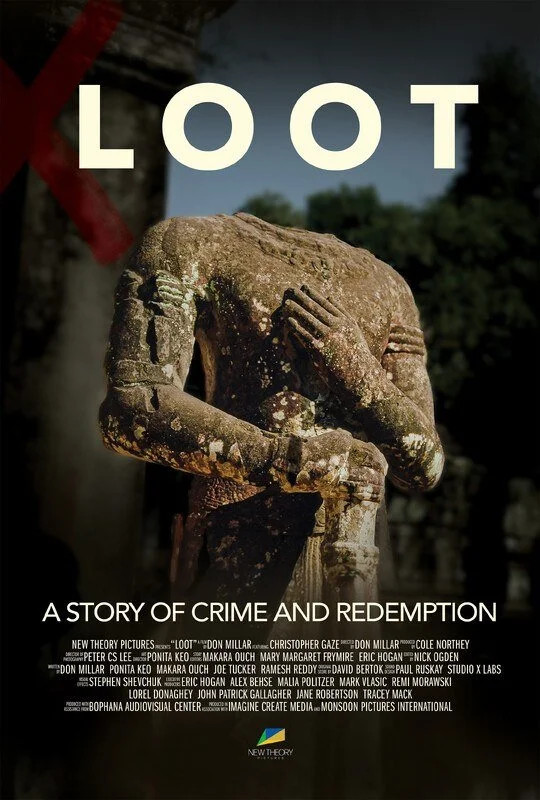
Loot: A Story of Crime and Redemption, directed by Don Millar for New Theory Pictures
Directed by Don Millar, the film traces the looting of Cambodia's temples during decades of conflict, the British dealer Douglas Latchford at the centre of the trade, and the long effort to bring the stolen pieces home. The team had been working on it for a long time, filming across Cambodia, Thailand, the US and the UK. I came in at the end of that process, for the moment the Met's pieces arrived back in Cambodia.
Preparing with the Production Team
I had a couple of meetings with producer Cole Northey and Don Millar, followed by a separate session with the film's cinematographer, Peter CS Lee, to go through his DP lookbook. It was a comprehensive, well-prepared document covering framing, movement, lighting and camera settings, so our conversation focused on the technical detail and the shooting style he wanted. From prep and planning through the shoot to footage handover, I was on the job for more than a week.
Filming with Thanaren Than
Thanaren is a former cultural heritage investigator who is personally connected to the statues, and her story ties the film to Cambodia's own efforts to investigate the looting. She was the first person we filmed. Her master interview was shot in the gardens of the National Museum as a two-camera setup, using the framings Peter had set out in the lookbook.
After the interview we filmed B-roll with her, all of it on the gimbal: riding in a tuk-tuk, walking along the riverside and making a blessing at a small pagoda. She then travelled out to the airport with us, and we filmed informal interviews with her along the way.
On the Runway at Phnom Penh International Airport
At Phnom Penh International Airport we were on the runway as the plane landed and filmed the crates carrying the artefacts being unloaded. It started raining soon after the artefacts arrived, which in Cambodia is taken as a sign of good luck.
We interviewed Brad Gordon in the rain about how he felt seeing the pieces come home. Brad is the American lawyer (now also a Cambodian citizen) who has represented the Cambodian government in its efforts to trace and recover looted antiquities for around a decade.
From the airport we followed the convoy back to the National Museum of Cambodia, where the museum team began unboxing the pieces.
The Handover Ceremony at the National Museum
The next day the artefacts were formally handed over at the National Museum in a ceremony presided over by H.E. Dr Phoeurng Sackona, Minister of Culture and Fine Arts, who has championed the campaign to bring Cambodia's looted heritage home. We filmed the unveiling of the returned pieces, which include a 10th-century stone sculpture of the goddess Uma from Koh Ker and a bronze Bodhisattva Avalokiteshvara that the Met bought from Douglas Latchford in 1992.
The Met is one of the major museums that had displayed looted Khmer pieces, and its decision to return them was a significant moment for Cambodia. We interviewed both H.E. Phoeurng Sackona and H.E. Pen Moni Makara, Secretary of State at the Ministry of Culture and Fine Arts.
The Technical Setup: Matching the Lookbook
Peter's lookbook set out a clear visual approach. Formal interviews were two cameras locked off, with talking heads shot into the corners of rooms and the subject lit slightly brighter than the background. Informal interviews were gimbal plus tripod or handheld. B-roll mixed wide static frames showing people in their environment with handheld coverage for moments that only happen once, and smooth gimbal moves for calmer sequences, establishing shots and moments of impact. He wanted gimbal movement to mimic the range of a set of speed rails, grounding the camerawork in classical technique.
For lighting, the direction was to lean into the naturalism of each location while pushing shape, shadow and contrast, and to shoot exteriors backlit when the sun was low. The colour reference sat between the bright sunlight and coloured streets of Cambodia and the cloudier light of London.
The production shot predominantly on the Sony FX3 in S-Log3 and S-Gamut3.Cine at 23.98fps, recording 10-bit 4:2:2 XAVC S-I. I shot with my Sony A7S III and Sony A7 IV, both in S-Log3 and recording to the highest-quality intra-frame codec each camera offers, so the footage would cut with the rest of the film in the grade. The A7S III shares its sensor with the FX3 and went on the gimbal for Thanaren's B-roll, and the two cameras ran together for the interviews. It's a similar two-camera interview setup to the one I used as DoP on CNA Insider's documentary on the Funan Techo Canal.
Loot on the Big Screen
Loot premiered at the International Festival of Films on Art in Montreal in March 2025 and has since screened at festivals including the Cambodia International Film Festival in Phnom Penh. It has now been officially launched in Cambodia and opened at Legend Cinema in Phnom Penh, Siem Reap and Sihanoukville on 16 October 2026. I attended a private screening there in early October 2026 and enjoyed seeing footage I'd shot on a big screen.
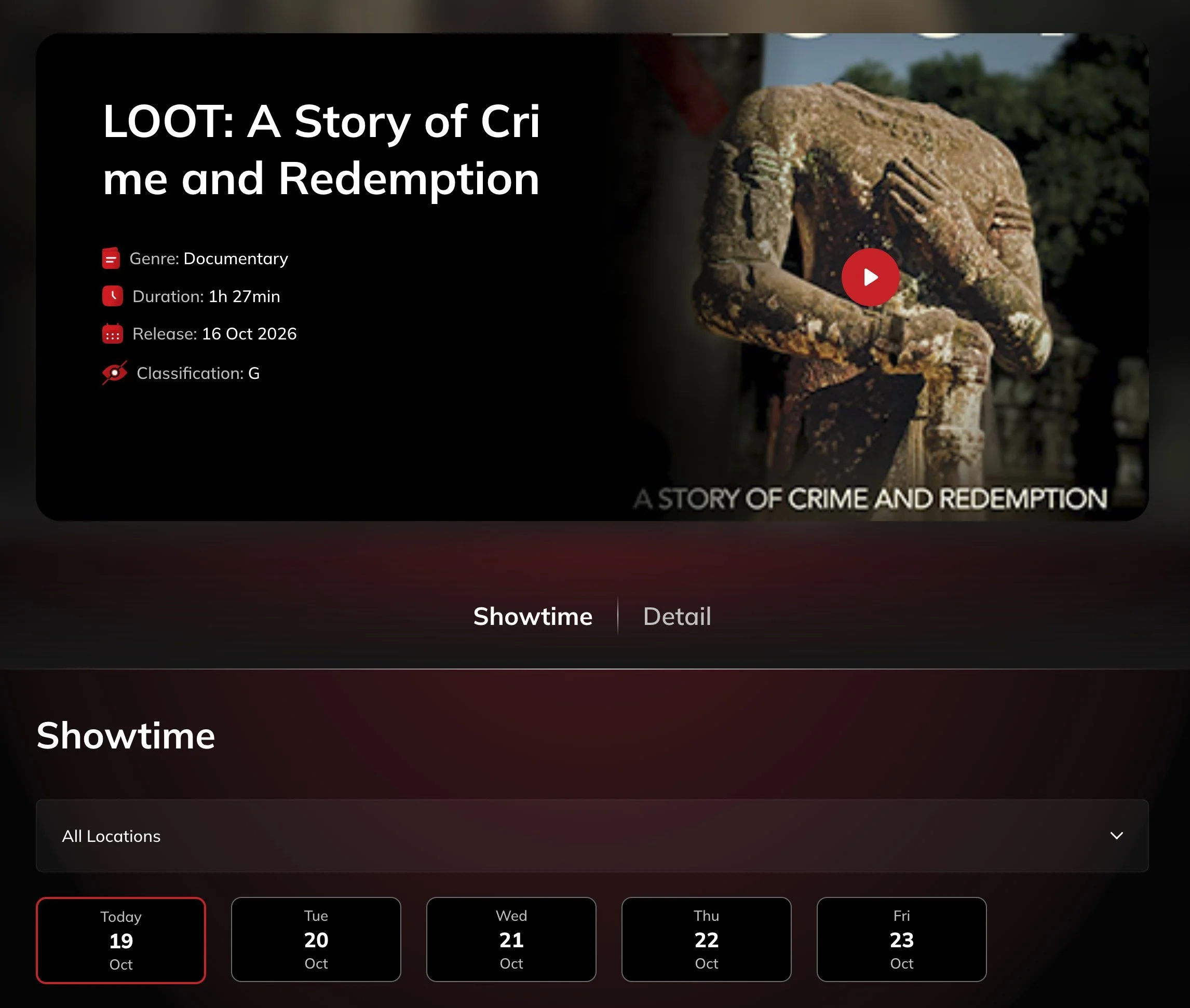
Loot on general release at Legend Cinema, Phnom Penh, from 16 October 2026
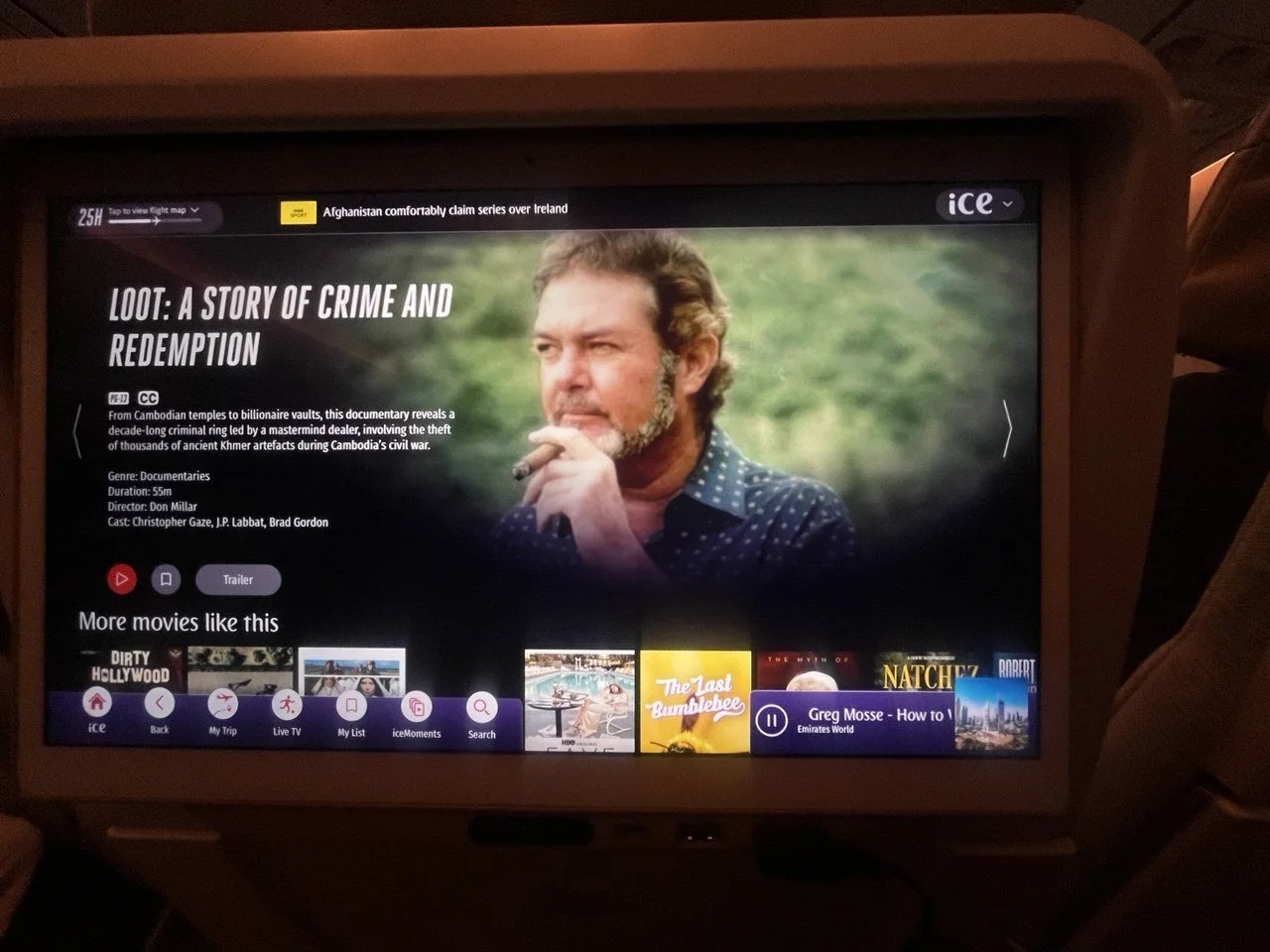
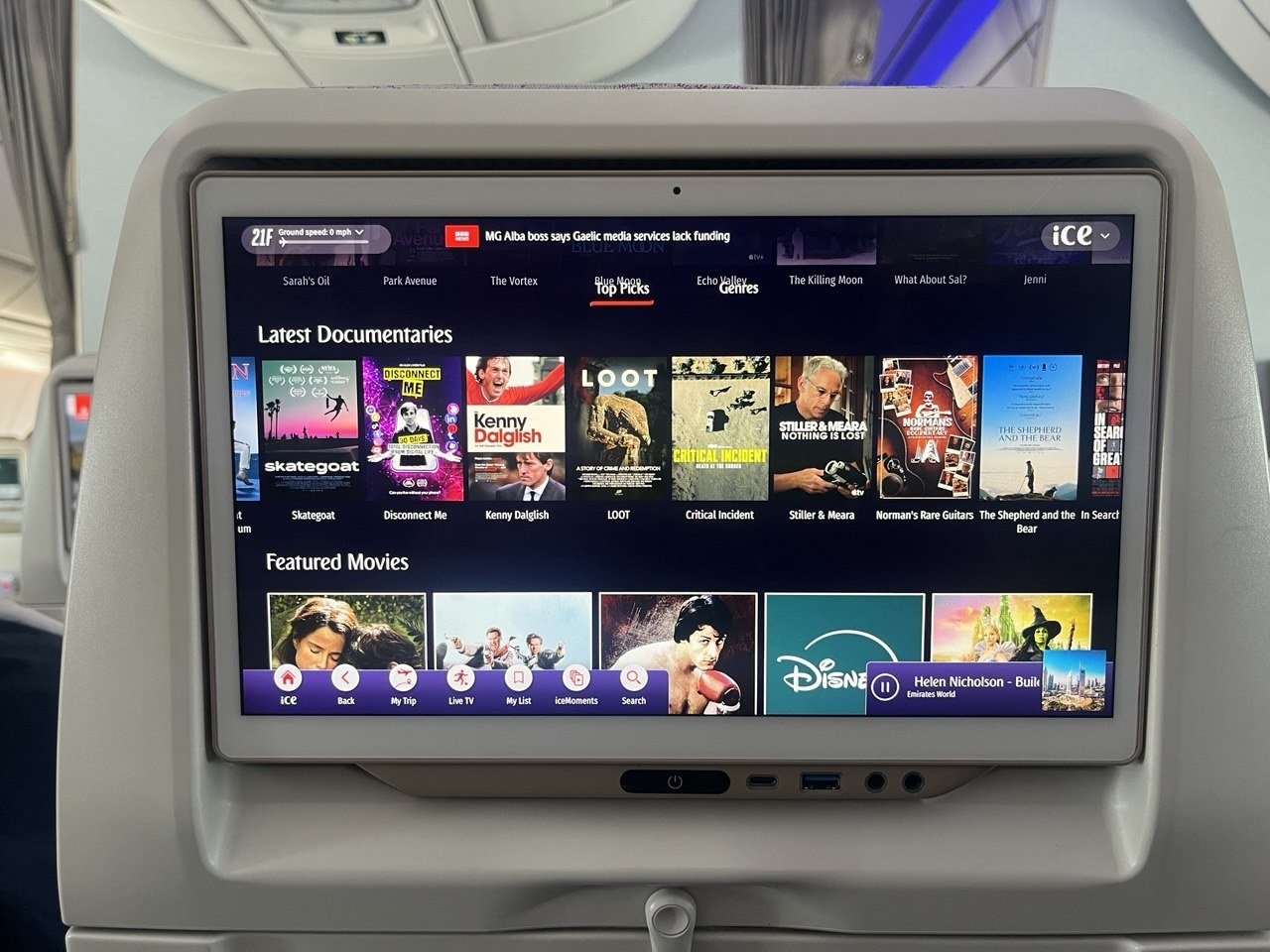
A 55-minute edit is also showing on Emirates' ice inflight entertainment, listed under Latest Documentaries, which I came across flying to France this summer.
My part in Loot was a small one. The team spent a long time building the story, and the edit by Nick Ogden and Nicholas T. Shepard brings it together well. Having spent four years on Last of the Elephant Men, which I co-directed with Arnaud Bouquet and Daniel Ferguson, I know how much work goes into a feature documentary before anyone sees it. Coming in at the end to film the pieces coming home was a good way to contribute to a story that matters a great deal to Cambodia.
You can see more of my documentary work as a director of photography and camera operator in Cambodia, or read about proposing and shooting the Cambodian side of the Thailand-Cambodia border story for CNA Insider. For commissions and collaborations across Cambodia and Southeast Asia, get in touch.
Working as Director of Photography on a CNA Insider Documentary About the Funan Techo Canal
At the end of last year I was brought in as director of photography on a 46-minute documentary for CNA Insider, the long-form current affairs strand of Channel NewsAsia.
At the end of last year I was brought in as director of photography on a 46-minute documentary for CNA Insider, the long-form current affairs strand of Channel NewsAsia. The film, Cambodia’s Mega Canal Has Vietnam Worried: What Does It Mean for the Mekong?, examines the Funan Techo Canal, a 180km waterway that will connect the Mekong River to the Gulf of Thailand, and the regional tensions it has stirred, particularly with Vietnam. It was produced by Loy Kheng Wee and executive produced by Daniel Heng, both of whom were in the field with me throughout the shoot. Daniel is an experienced hand with a deep knowledge of Southeast Asia and the Insight series.
It was a five-day shoot across multiple locations in Cambodia: Phnom Penh, the groundbreaking site of where the canal will be built, Battambang, and the Phnom Penh Autonomous Port. Over the course of the week we filmed more than ten interviews, and during interviews I operated two cameras to give the editor a choice of angles.
46-minute CNA Insider documentary on the Funan Techo Canal, Cambodia, director of photography: George Jefferies
The Technical Setup
It was a multicam shoot. During interviews, I worked with a Sony FX6 and Sony A7S III, with the FX6 as the wider master and the A7S III as the closer camera. I also mounted the A7S III on a gimbal, giving different shooting options at all points and allowing me to move quickly and efficiently between handheld, gimbal, and tripod as each situation required. Sound was recorded both on a boom mic and a concealed lav mic, which gave us clean options in post regardless of the environment.
Drone work was also part of the brief. The local fixer obtained the necessary permissions to fly in Phnom Penh, and I flew the DJI Air 3 across several locations: the Mekong River, the Cambodian-Japanese friendship bridge crossing the Tonle Sap, rice paddies and a rice processing facility in Battambang, the Koh Pich area of Phnom Penh, and the Phnom Penh Autonomous Port where cargo boats currently make the journey down the Mekong through Vietnam. That footage was particularly relevant to the story, as those are the boats that would eventually use the canal rather than the Vietnamese route.
Interviews and Locations
The range of interview subjects gave the film its shape. In Phnom Penh we filmed with Chea Thyrith, spokesperson for the CPP, along with a range of experts offering analysis of the canal’s economic and geopolitical implications. At the groundbreaking site we spoke with a number of local residents living in the path of the canal. They knew little about what relocation would mean for them, as compensation, timing, and next steps were all still unclear, largely because the project itself had yet to move beyond its early stages. At the Port Authority building we interviewed a representative about the commercial case for the canal. In Battambang, we filmed with a rice factory owner who currently exports through Cambodia having previously relied on Vietnamese ports, and shot in the rice paddies where the crop is grown.
Lighting and operating across that many locations over five days, with two cameras, is a logistical undertaking. Each location brings its own challenges: ambient light direction, background management, the fast pace at which a documentary crew moves. Getting consistent, broadcast-quality results across all of them is the job.
The Story Itself
The Funan Techo Canal is a project that raises significant questions. Cambodia argues the canal will reduce its reliance on Vietnamese ports, through which roughly a third of its global cargo currently passes. Vietnam, meanwhile, is concerned about the canal’s potential to divert water flows from the Mekong Delta, a river system already under pressure from upstream dams and climate change. There are also questions about whether the waterway could serve Chinese military purposes, though experts note it will not be deep enough to accommodate naval vessels.
When we were shooting, there was genuine uncertainty about the project’s timeline and funding. People we spoke to were largely supportive of the idea, but specifics were hard to come by. Since filming, a financing deal between Cambodia and China has been finalised, which gives the project more concrete footing, though whether it meets its 2028 completion target remains to be seen.
Working with the Production Team
It was good to work alongside Daniel Heng, whose knowledge of the region showed throughout the shoot. I also worked with producer Loy Kheng Wee, for whom this was her first shoot in the field as a producer. I hope it was a useful experience and that she has gone on to make many more interesting documentaries.
CNA Insider has been one of the more consistent commissioners of serious, long-form journalism in Southeast Asia. Working on a documentary of this scale and complexity, covering a story with genuine regional significance, was a good addition to the slate.
Working on something similar? Drop me a line, I’d be happy to discuss how I can help.