

Shooting Producer on the Song Saa Collective’s Regenerative Tourism Film, Koh Rong Archipelago, Cambodia
In June I worked as shooting producer on a short film about the Song Saa Collective in Cambodia’s Koh Rong Archipelago, for Pacific Asia: Tourism with Purpose.
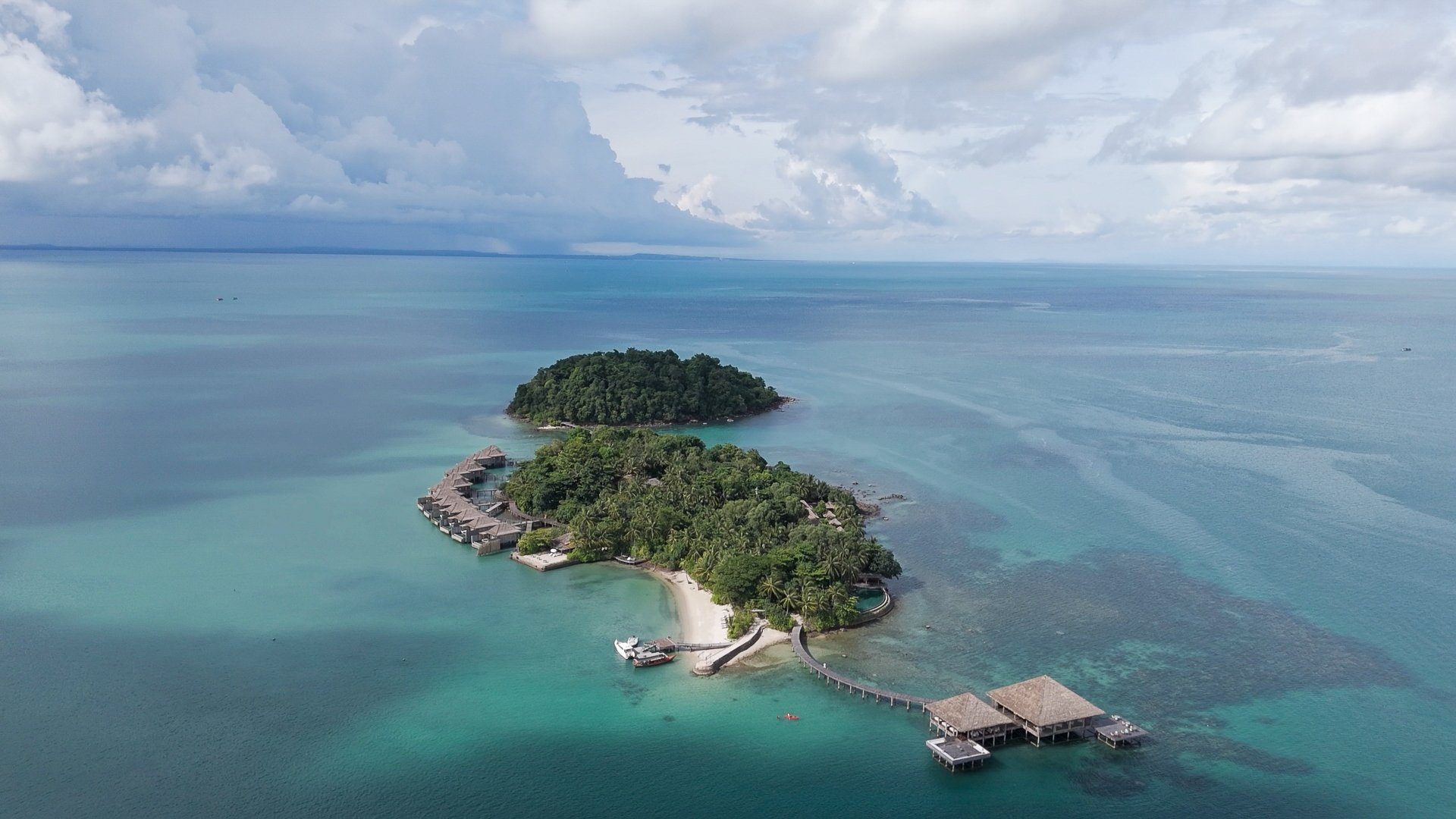
Song Saa Private Island from the drone
In June I worked as shooting producer on a short film about the Song Saa Collective in Cambodia’s Koh Rong Archipelago. Regenerative Tourism is part of Pacific Asia: Tourism with Purpose, a digital series that the UK production company Content With Purpose produces for the Pacific Asia Travel Association (PATA).
The film looks at how Song Saa Private Island, a resort off the Cambodian coast, funds the marine conservation and community work of the Song Saa Foundation. I was on the job with Vicheka, my long-term assistant, who has worked with me on a lot of shoots.
A change of plan on Thursday evening
The shoot came together at short notice. One of the people due to be featured had returned to their home country for family reasons, so I had a call with Content With Purpose and Melita Koulmandas, the founder of the Song Saa Collective, on the Thursday evening to work out what to do. Morokot Long, the Song Saa Foundation’s marine conservation and community engagement officer, agreed to step in. A holiday was coming up and she was due to travel back to her hometown, so we had to film before she left.
We made the final decision that evening. I packed the kit that night, started prep at 5.45 the next morning, and Vicheka and I were in a taxi out of Phnom Penh at 6am. At the coast we took Song Saa’s speedboat out to the island, and we filmed on Friday 19 and Saturday 20 June.
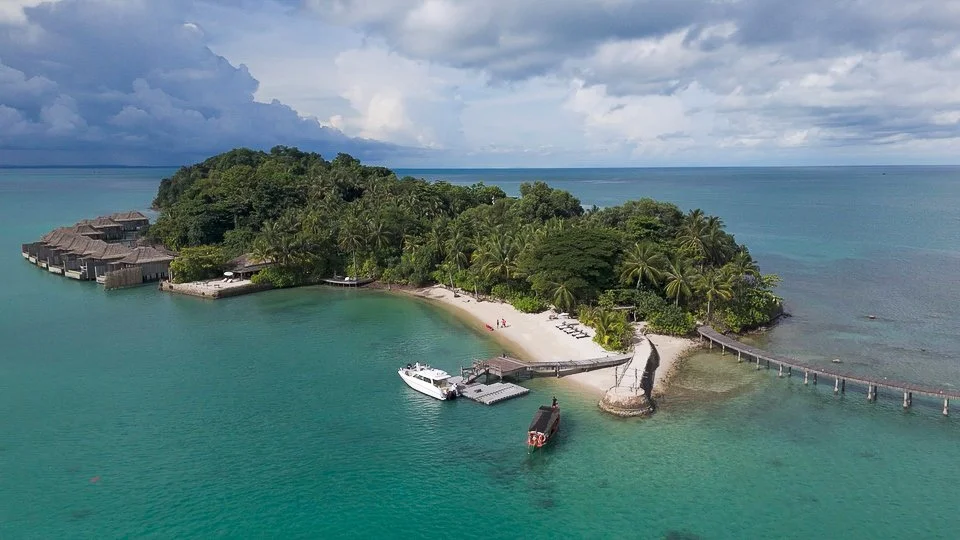
Arriving at Song Saa Private Island
I arrived slightly discombobulated, convinced I’d lost an hour somewhere. Song Saa runs on Hong Kong time, an hour ahead of the rest of Cambodia, so the island’s clocks and mine weren’t aligned.
Working with Content With Purpose
Content With Purpose specialises in ethical production. To keep the carbon footprint of its shoots down, it hires local crews rather than flying people in, which is how the job came to me in Phnom Penh. The production manager was Amy Allport.
Three interviews, two cameras
Content With Purpose wanted a two-camera interview setup, and I ran the interviews myself. The Sony A7 IV was A camera, with the A7S III on the second angle. I lit with a Zhiyun Molus X100 and recorded sound from a Sennheiser MKH 416 on a boom and a Sennheiser G4 radio mic, both going into the Sony XLR-K3M adapter, belt and braces.
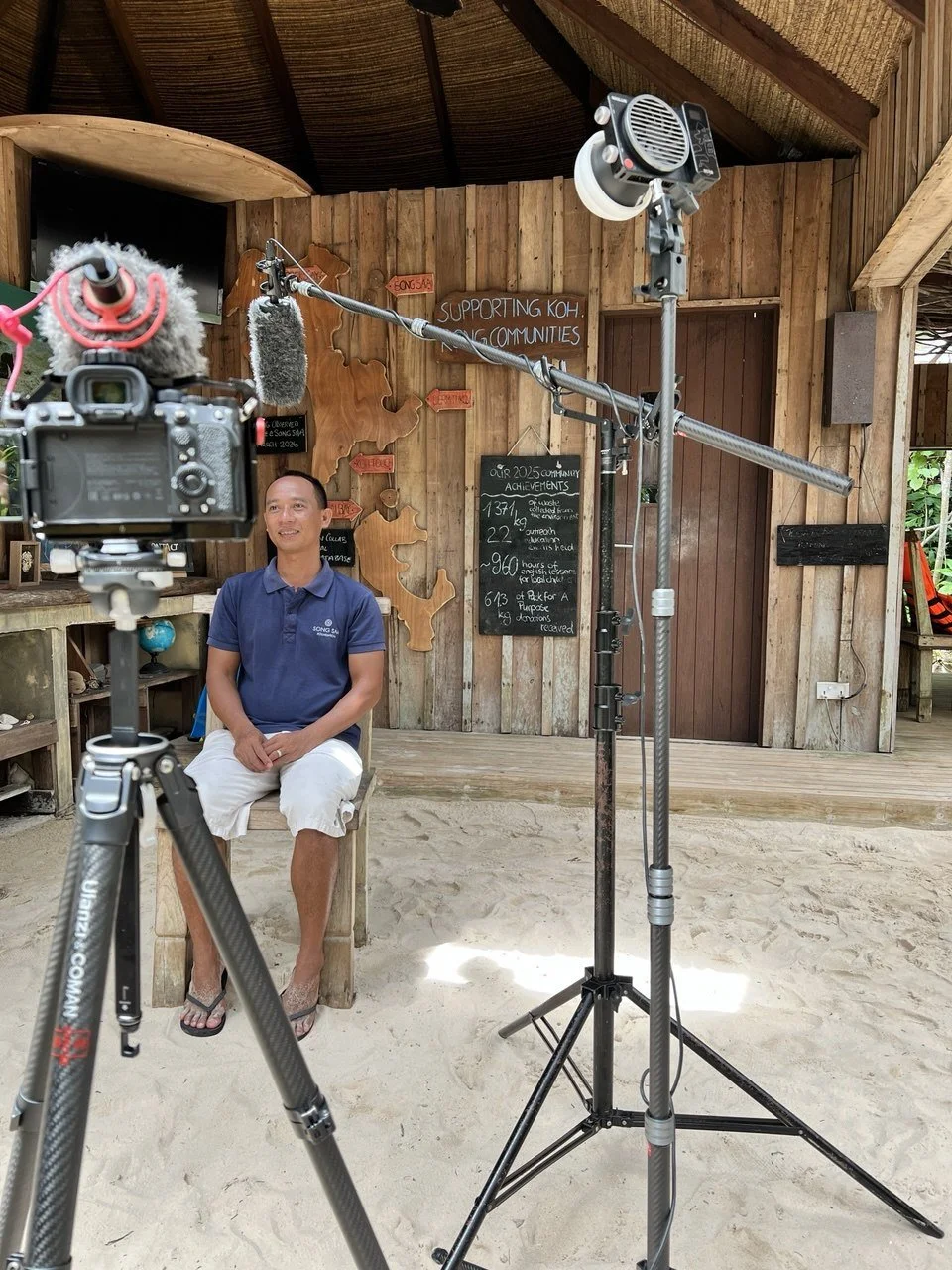
The two-camera setup for Sideth Chun’s interview at the Discovery Centre.
Melita Koulmandas, Song Saa Collective
Melita Koulmandas is the founder and CEO of the Song Saa Collective. We interviewed her in one of the island’s villas, a stilt house looking out over the sea.
“I first found myself out here 20 years ago, in 2006,” she says. “When I first arrived, you could see what on the surface appeared to be this incredible, stunning, pristine environment was very rapidly in decline. Fish stocks had been pushed close to collapse. It was becoming more and more challenging for these fishing communities to provide for their families.”
She started working with the local community and the fisheries, and the house reef around Song Saa became, in her words, “the starting point for Cambodia’s first marine reserve.” The Song Saa reserve was the first marine reserve to be registered in Cambodia.
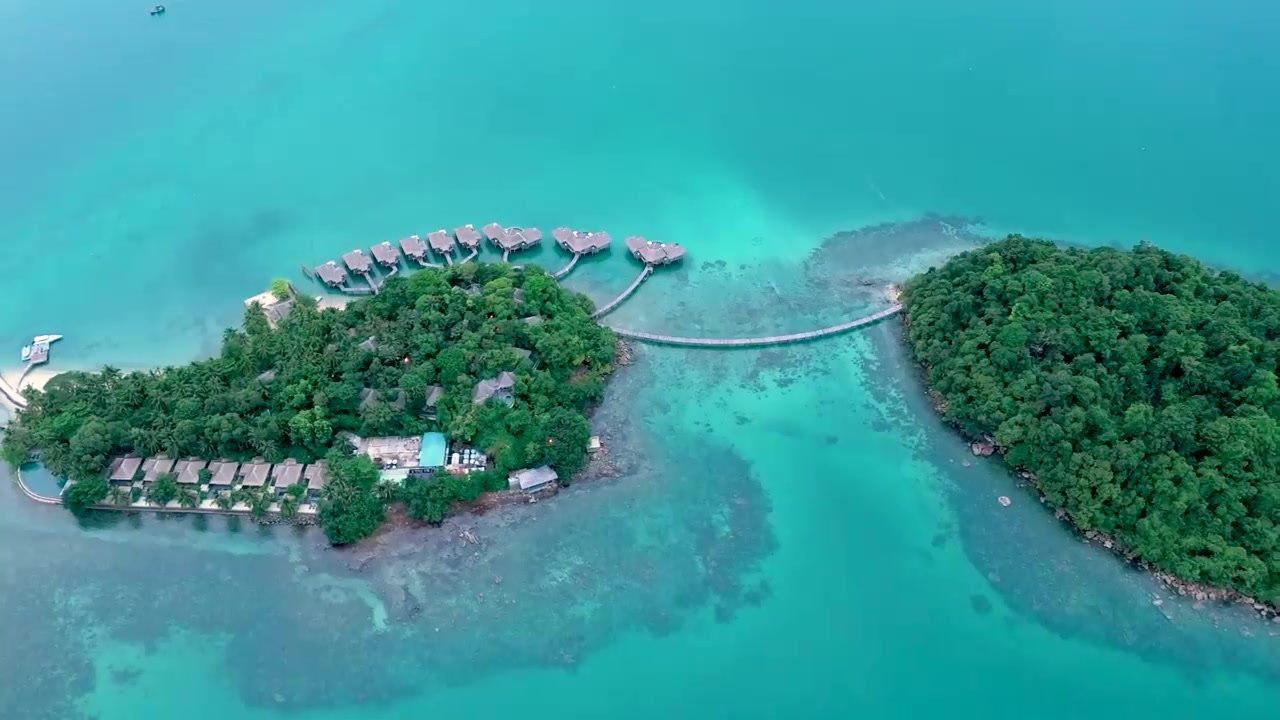
The two islands of Song Saa and the house reef between them
“Within 18 months we saw the fish stocks start to come back,” she says. “We saw baby barracudas, we saw spotted stingrays, and I was able to witness regeneration happening in real time.”
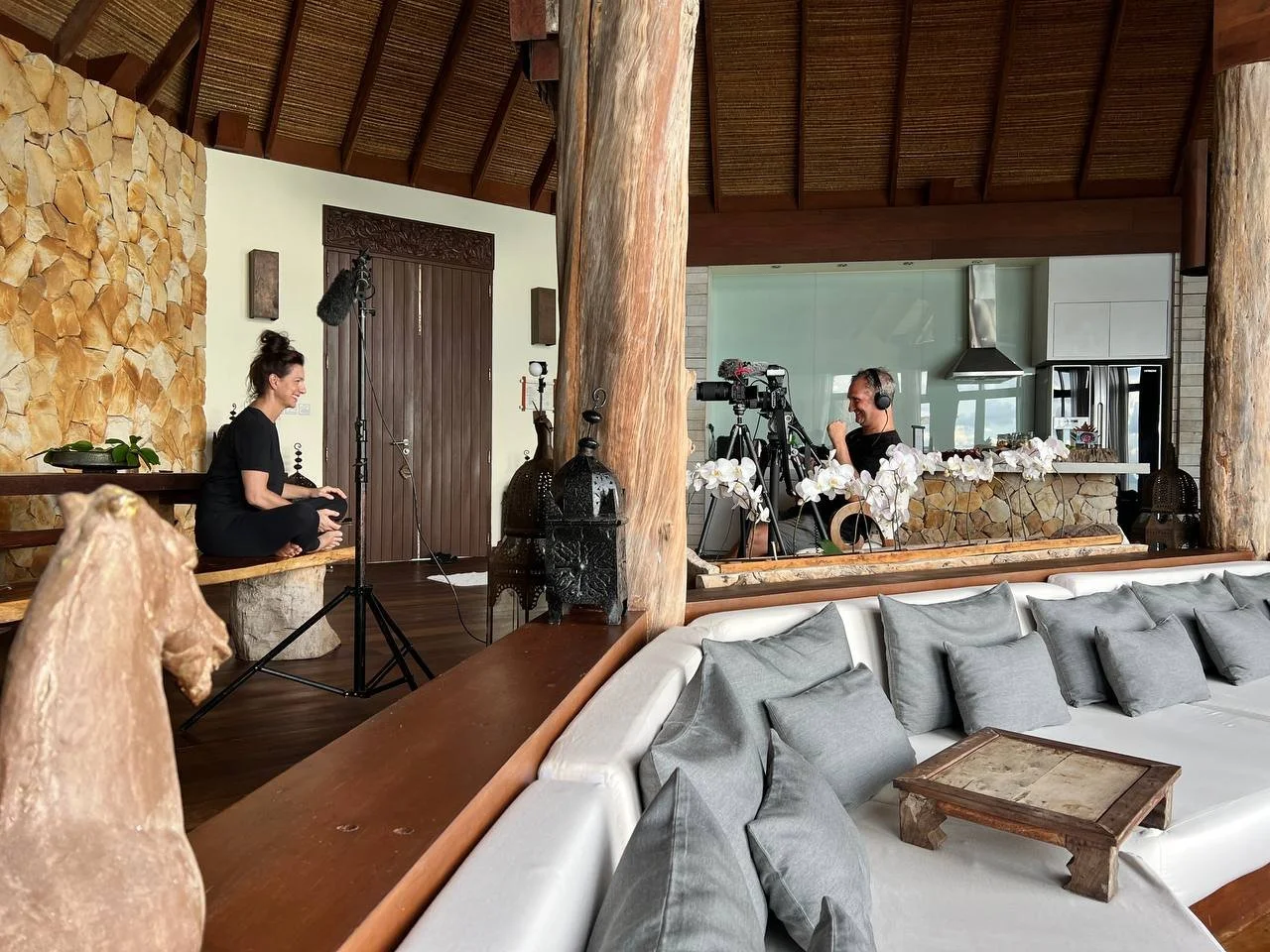
Interviewing Melita Koulmandas in one of the villas on Song Saa Private Island.
Morokot Long, Song Saa Foundation
Morokot’s interview was shot on the beach in the late afternoon, with the sea as a backdrop. She runs the foundation’s seagrass surveys, which she describes as “very detailed, metre by metre.”
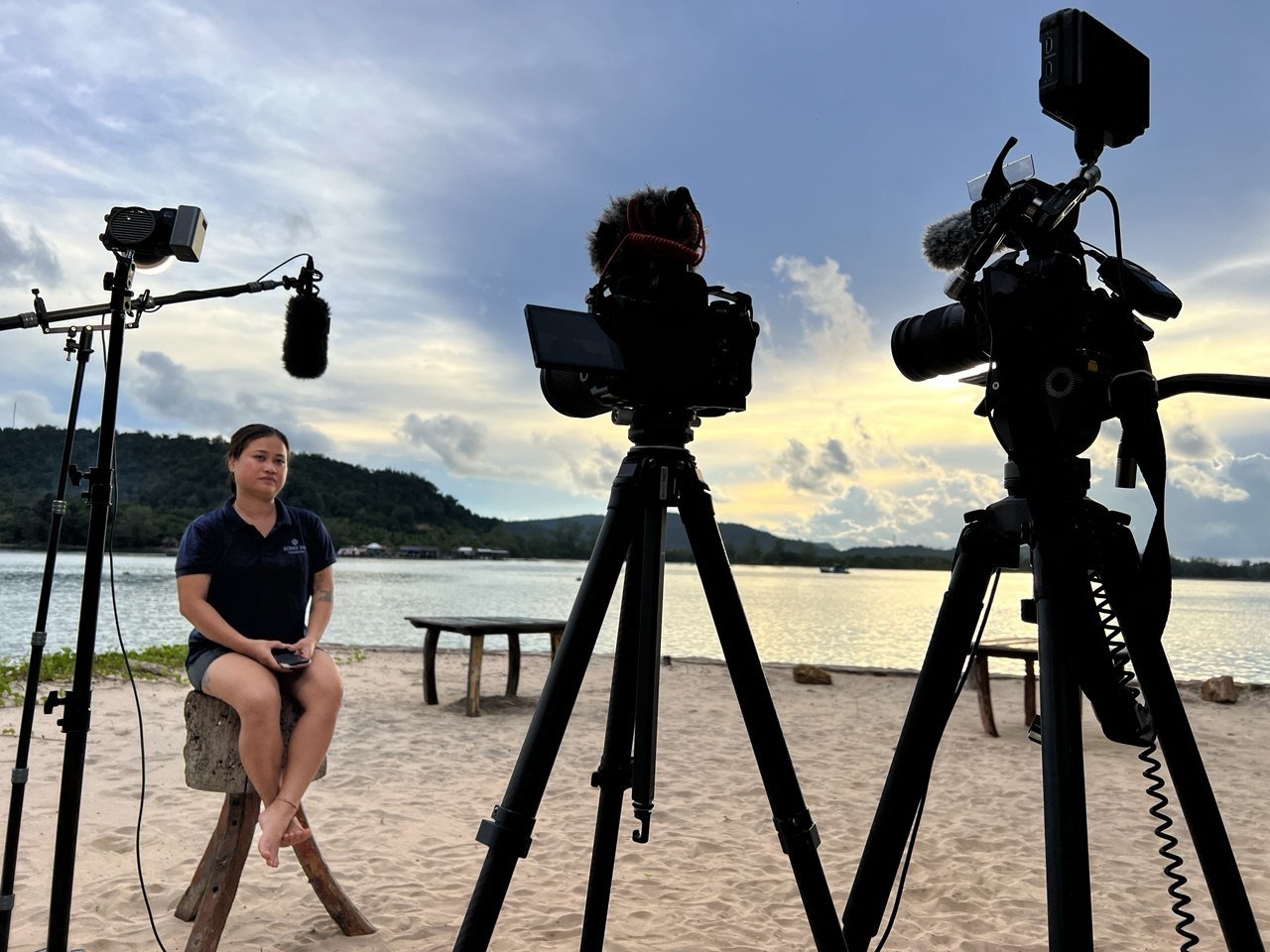
Setting up Morokot Long's interview on the beach as the sun sets.
“Seagrass bed is one of the most important marine habitats,” she says. “It sustains a lot of life. It acts as a nursery ground for the juvenile fish, protects our coastline from waves and erosion. It also acts as a carbon sink.”
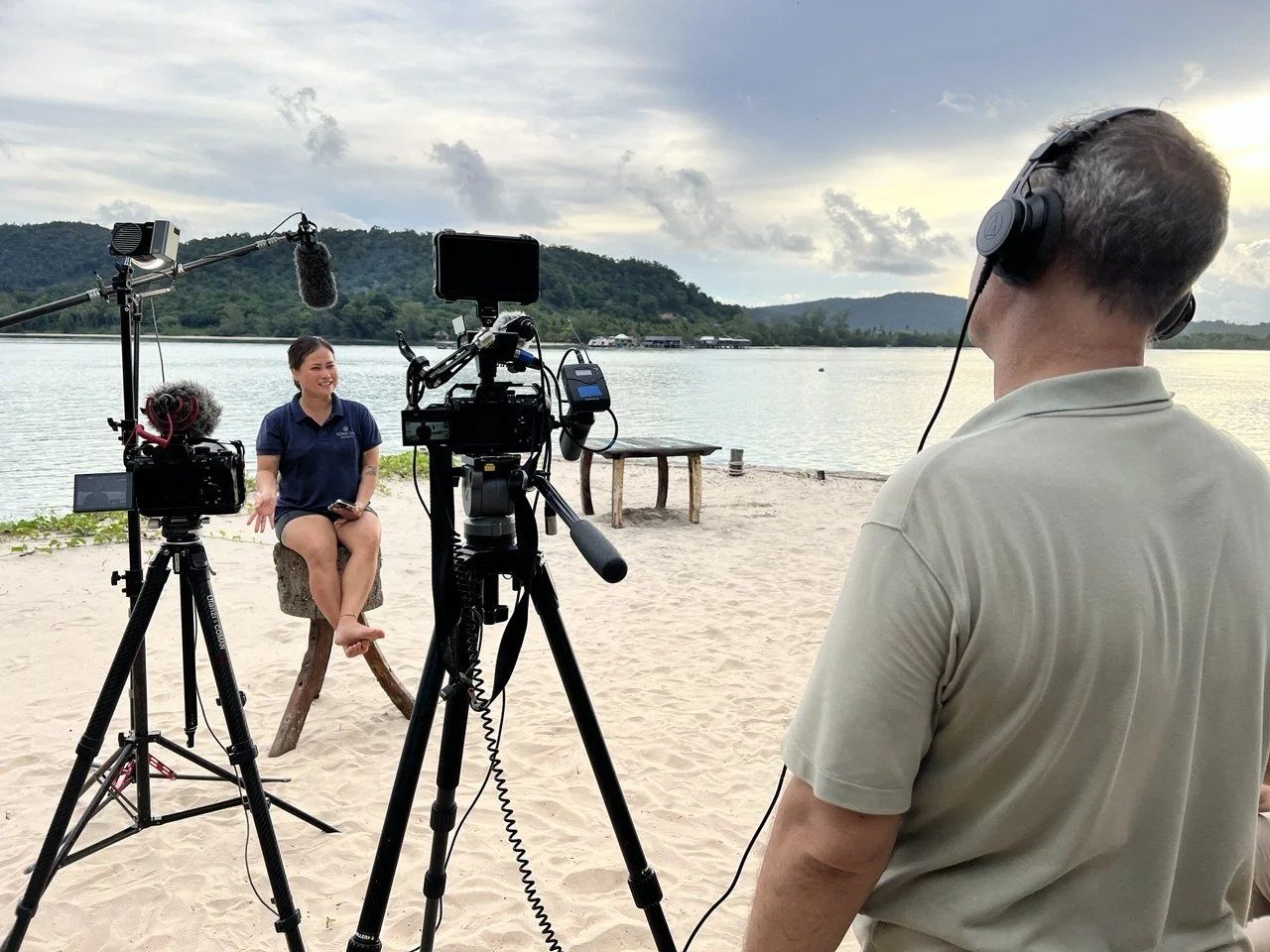
Morokot Long on the beach, with the second camera on the left.
Sideth Chun, Song Saa Foundation
Sideth Chun is the foundation’s community liaison officer, and we filmed his interview at the Discovery Centre. Morokot told us he’d recently qualified as a scuba diver. “When the local community takes this as their ownership, people like to protect what they care about and what they love,” Morokot says.
Sideth runs workshops on coral species for children in the community and takes them swimming. “They see the coral growing and they’re really interested,” he says. “They said they want to be like the part of the marine science and take care of their own marine environment.”
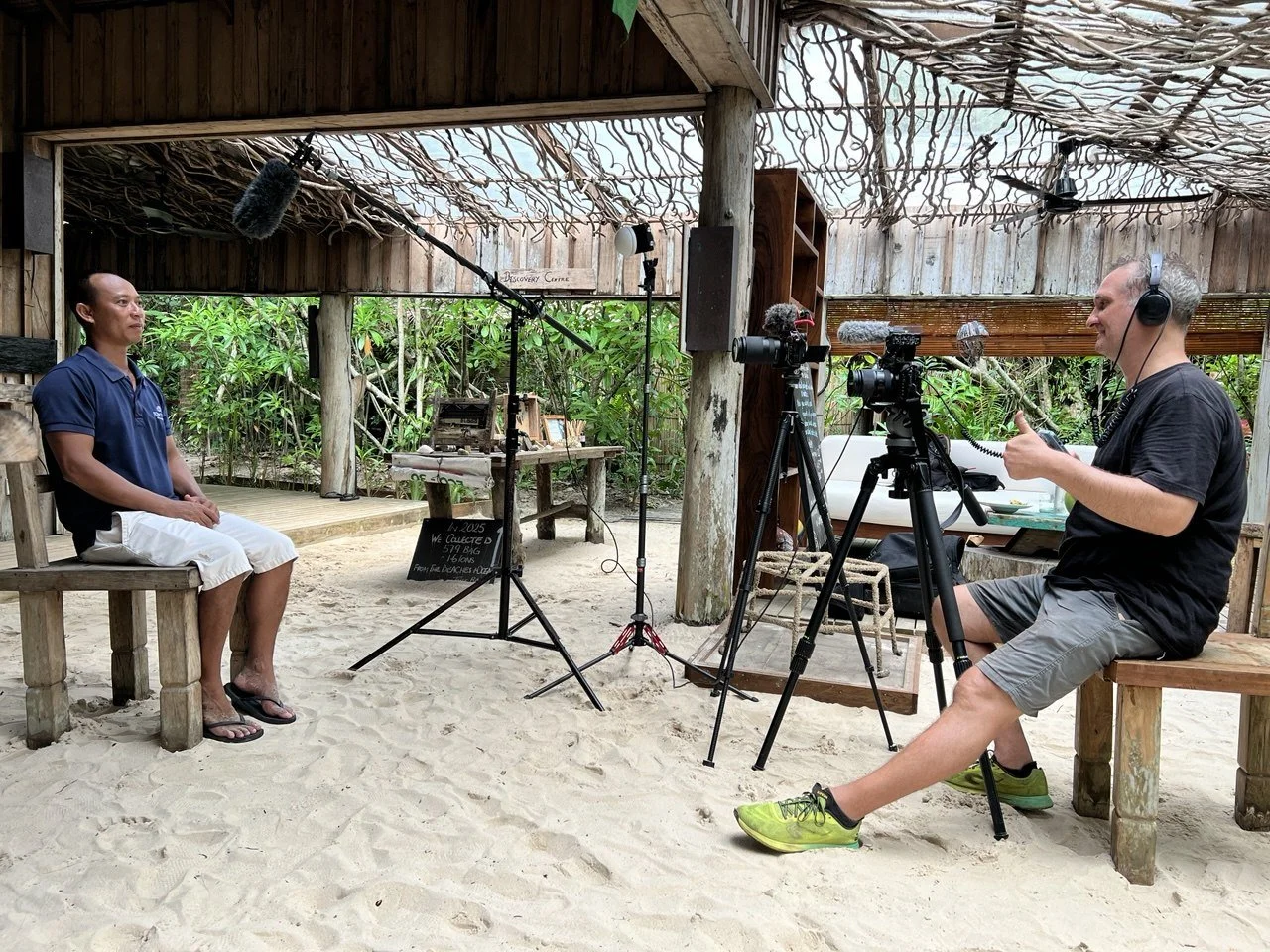
Interviewing Sideth Chun at the Discovery Centre.
On the water and in the air
Between interviews, we went out on the foundation’s boat with Morokot, Sideth and the dive team as they kitted up. I used the A7S III on the gimbal for the moving shots on the boats.
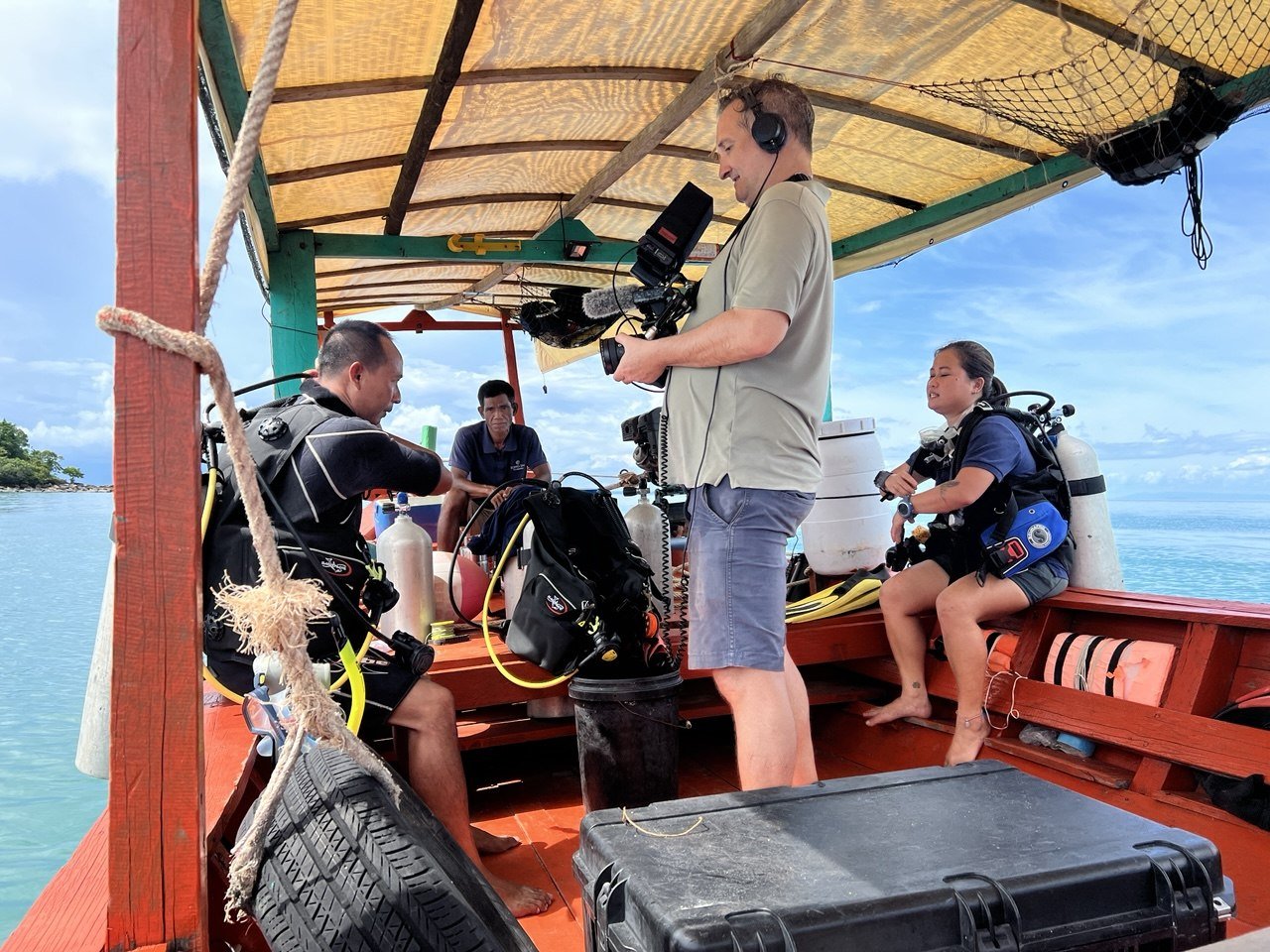
Filming the dive team as they kit up.
I shot the aerial footage on the DJI Air 3, covering the island, its boardwalk and the house reef. I’ve written more about flying drones in Cambodia and the permissions involved.
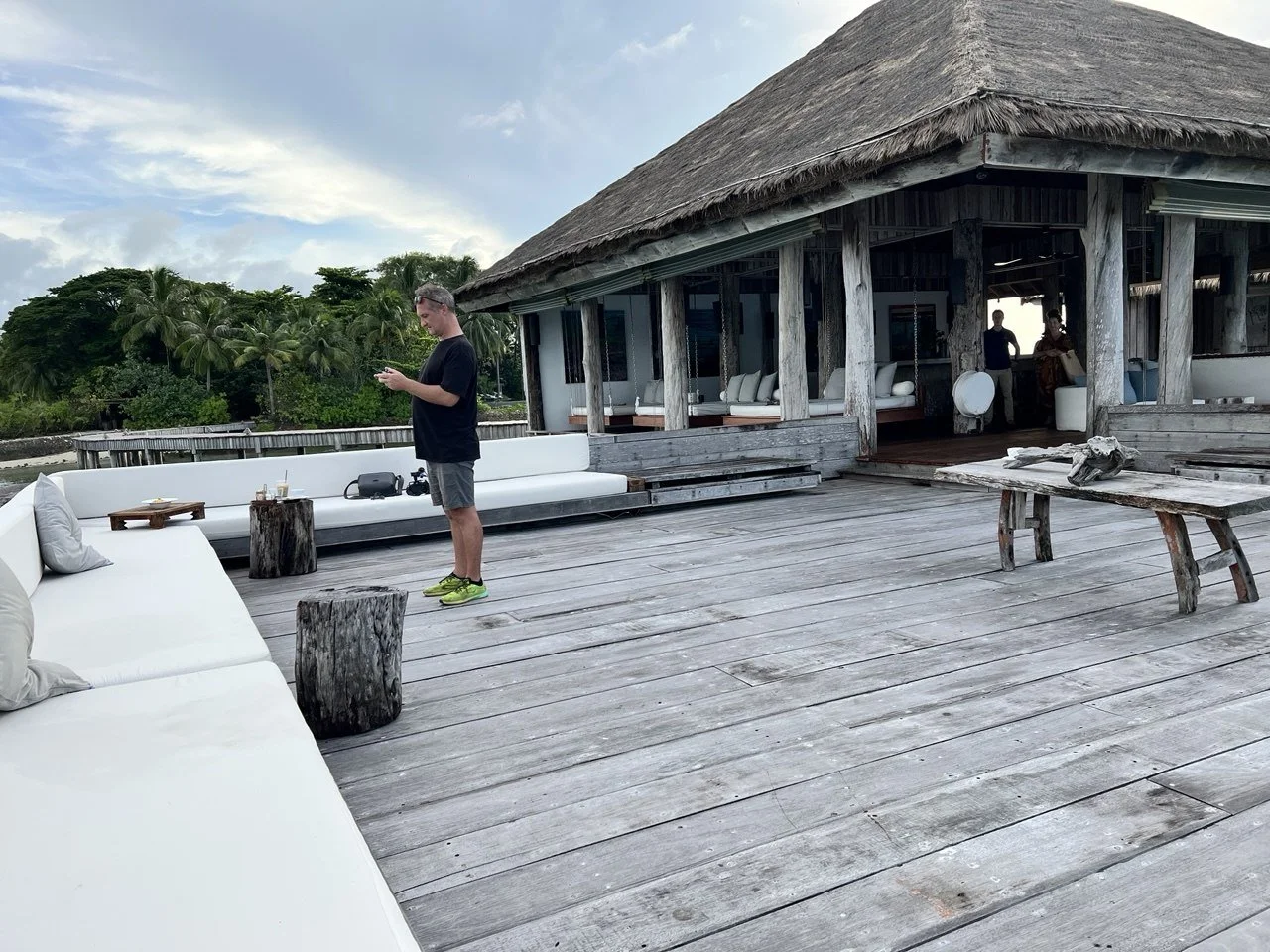
Flying the Air 3 from the deck on Song Saa Private Island.
Tourism that pays for conservation
Six years after Melita first arrived, she designed and built Song Saa Private Island to support the conservation work, alongside an international not-for-profit foundation.
“The resort commercial business became the engine,” she says. “It provided infrastructure for the conservation work, provides housing for the marine scientists and the team to live in. It brings awareness to this area through media and PR. And then through guest donations, grants, fundraising through the foundation, we’re able to conduct data-driven research.”
It’s the same link between visitors and conservation that I saw on the Tonle Sap, where protected bird sanctuaries bring income to communities through eco-tourism. Melita summarises this perfectly at the end of the film: “Tourism has to move from extraction to contribution.”
Staying on the island
It’s not often I get to stay somewhere like Song Saa, and I think Vicheka enjoyed it even more than I did. We didn’t have time to make much use of the island’s facilities, but we did eat at the restaurant. My highlight was an Asian-style confit duck salad with green mango, where the acidity of the mango cut through the saltiness of the duck.
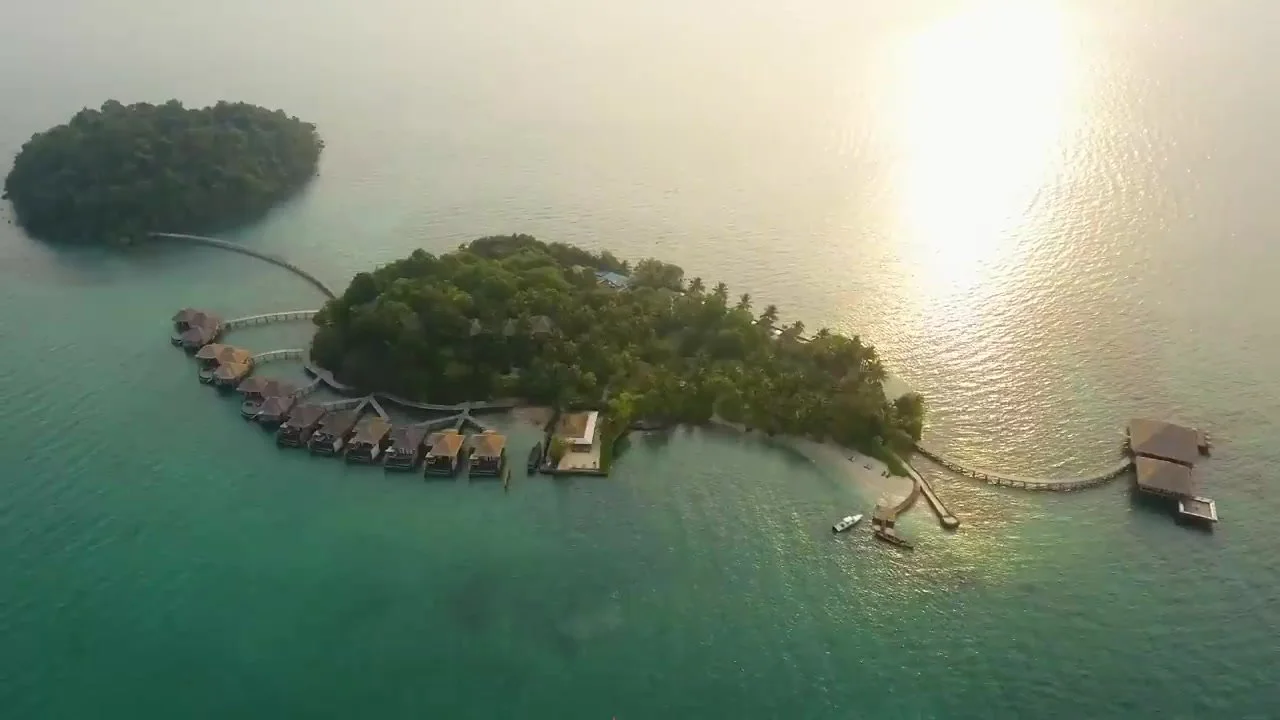
The overwater villas on Song Saa Private Island.
Handover and release
At the end of the shoot, I uploaded all the footage to Content With Purpose’s Drive for the edit. Pacific Asia: Tourism with Purpose was previewed at PATA Travel Mart 2026 and launched in Bangkok on 8 September 2026. The films are free to watch on Content With Purpose’s site, alongside partners including the Hawai’i Tourism Authority and Travelife.
Thanks to Melita, Sideth and the Song Saa team, and to Morokot for stepping in at short notice. If you’re after a shooting producer for a travel or conservation story, I’ve also produced, directed and shot segments for the BBC Travel Show. You can see more of my work as an NGO videographer in Cambodia.
Working on something similar? Drop me a line, I’d be happy to discuss how I can help.
On location in Stung Treng – Filming a case study for UNICEF’s Generation Future Programme
It’s always good to get out of Phnom Penh on assignment and working as an NGO videographer on an assignment for UNICEF was no exception.
I’d made a video case study about Panha just as she started started a role as a team leader as part of the Code for Girls project.
It was always the plan to make a follow up video of Panha to see the progress she had made over the
Panha spoke about the new skills she had learnt. ‘Now, I can use code in my designs
to make all kinds of models,’ she said.
We also interviewed Lida, Panha’s IT teacher. She spoke about the progress Panha had made.
‘It makes me very happy to see Panha undergoing such a positive transformation. She has gone from a girl with basic typing skills to a girl who is confident in writing code,’ she said.
Panha also spoke about the training she had provided to her team members.
‘Over the past 6 months, I have trained my team members in STEM subjects. We’ve learned about using a 3D printer and coding,’ she said.
Chaily, one of Panha’s team members was very positive about the training Panha has given her.
‘Panha has helped to improve my drawing skills, and she’s improved my leadership
and teamworking skills,’ she said.
Panha has had to overcome difficulties to provide the best training she can.
‘Even though I’m a very shy person. My confidence has improved,’ she said.
Panha plans to set up a dedicated STEM room at her school and wants to study computer science at university. She has even inspired Chaily to pursue a university course in civil engineering.
I wish both Panha and Chaily the best of luck in the future. It’s important that increasing numbers of girls enter the STEM sector as they are currently underrepresented. Hopefully they can both continue to be role models and inspire other girls to pursue their goals.
Please don’t hesitate to contact me if you have any video projects you’d like to discuss.
On Assignment for WHO - Directing 4 Videos About their Social Prescribing Campaign
I was commissioned by the WHO Western Pacific Regional Office to direct 4 videos about their Social Prescribing for Healthy Aging programme in Cambodia to form part of their training toolkit. The toolkit provides implementing partners with an overview of the best practices of how implement social prescribing at the community level.
The Social Prescribing for Healthy Aging programme is a way for healthcare workers to connect people to a range of non-clinical services in the community and to help the elderly not feel anxiety, loneliness or depression.
The toolkit is designed for policy makers and community health centres to help them run effective social prescribing schemes.
The brief was to make 4 videos to highlight the key aspects of successfully implementing social prescribing schemes.
The first video (above) features Dr Kao Sovandara, a lecturer at The Royal University of Phnom Penh and part of the lead team implementing social prescribing in Cambodia. He gives an overview of the programme, the training they provide and how that works at a grassroots level.
The second video features Yem Sameoun, who is a commune councillor responsible for running the scheme in her community. She talks about the training she receives, the work she does in the community and the positive outcomes.
The third video features Nget Krin, an elderly community member. She talks about the situation she faces, the support she receives and how that makes her feel.
The fourth video features Dr Khan Sareth, a lecturer at The Royal University of Phnom Penh and part of the lead team implementing social prescribing in Cambodia. He gives an overview of what they’ve achieved and reflects on how the scheme can be improved in the future.
While the project is intrinsically nebulous in nature, I hope it can have an impact in Cambodia, regionally and in the rest of the world. As the world’s population is aging, it’s increasingly important to make sure everyone feels included within their communities.
Veasna's Story - Working as an NGO videographer on a case study for VSO
This is the second case study I made on assignment as an NGO videographer for VSO.
The video tells the story of Veasna and the positive impact VSO’s RECOVER project has had on her livelihood.
As part of the project, Veasna received agricultural training and financial support to improve her growing facilities.
Held in the community with other vegetable growers the training shows Veasna best practices about what to grow, how to grow it and pest control.
Veasna has used the financial support she received to construct a net house for growing higher value crops.
VSO have also set up agricultural cooperatives. This gives the vegetable growers additional selling power as the cooperative can sell larger quantites direct to market.
They sign contracts to guarantee fair prices for their vegetables and a constant source of income.
A storage facility has also been built in the community so the vegetable growers can store their vegetables to cut down on wastage and to be able to control the sale of the vegetables they grow to the market.
It was great to see the positive relationship Veasna had with Ravuth, the trainer, and how she is looking to expand her growing activities in the future so she can support her young family.
Below is the final video:
And here’s the shorter version I made for social media:
NGO videographer for UNICEF and LEGO project in Siem Reap, Cambodia
I was assigned to work as an NGO videographer to produce a training video for UNICEF and LEGO’s Build the Change project in Siem Reap, Cambodia.
UNICEF and LEGO have been corporate partners since 2015. Their latest collaboration is the Build the Change project, which will be taught in classrooms across Cambodia. The aim is for Cambodian students to use their imaginations and LEGO to work no a project that expresses their hopes for the future. Photos of the projects are then uploaded to a portal for the project and LEGO aims to share the projects to try and bring about lasting change using the students ideas.
I was asked to make a training video that helped to support the teacher’s book to clearly and concisely demonstrate to Cambodian teachers how to set up and run the activity in their classrooms and share the projects.
The video was a challenge as the project hadn’t been launched in Cambodia and no one had experience of teaching the activity. I worked closely with Bunly and the communications team at UNICEF to find solutions to make a training video that clearly explains the process of running the activity in a classroom, so that teachers across Cambodia understand how to set up and run the activity in their classrooms. The team at UNICEF were very happy with results.
You can watch the video above and you can see more examples of training videos here and more examples of my work as an NGO videographer here.