
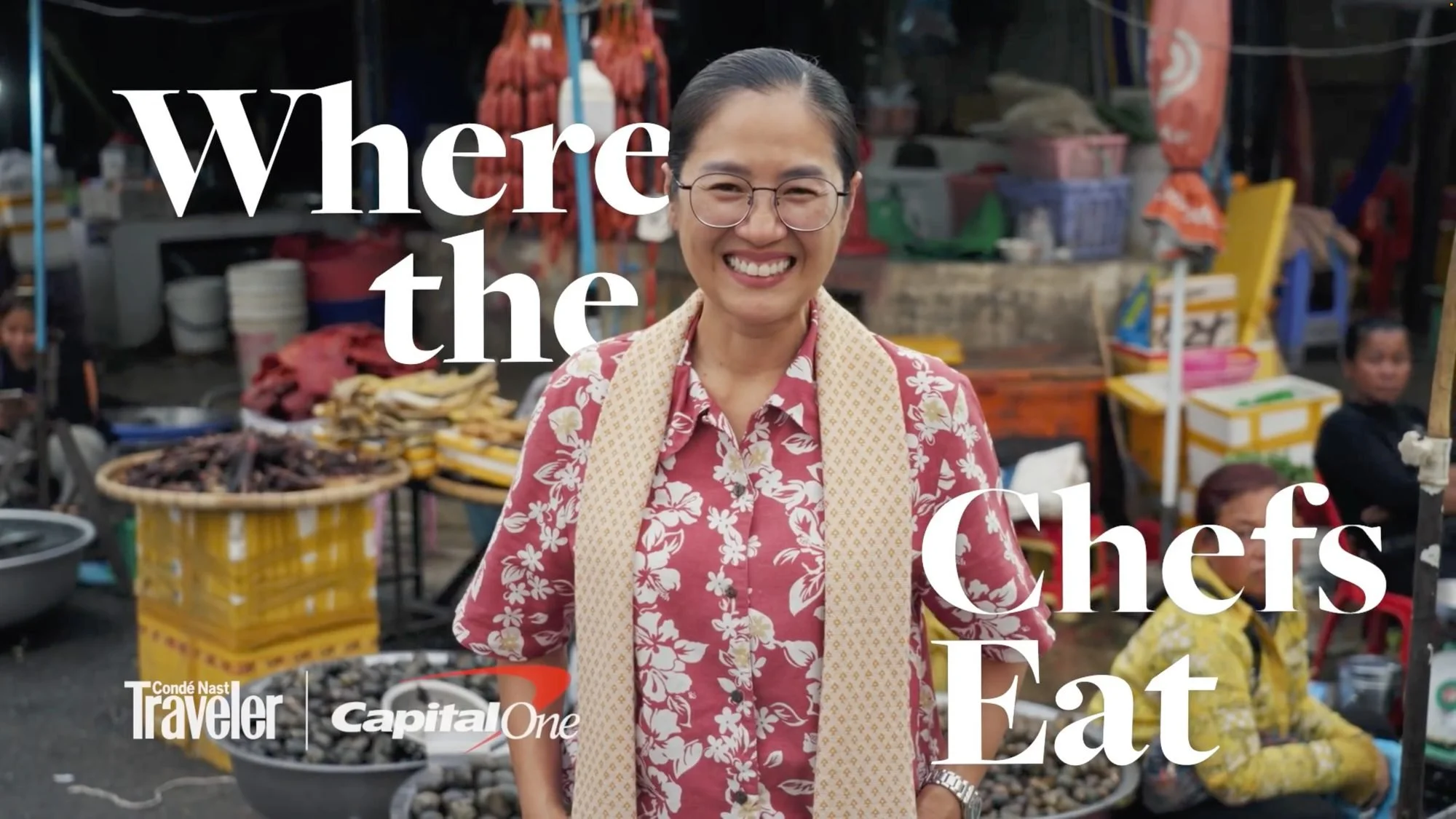
Director of Photography on Condé Nast Traveler's Where the Chefs Eat in Phnom Penh
I was director of photography on Condé Nast Traveler’s Where the Chefs Eat episode in Phnom Penh, which has now passed a million views on YouTube.
I was director of photography on Condé Nast Traveler's Where the Chefs Eat episode in Phnom Penh, which has now passed a million views on YouTube. A Pro Chef's Favorite Places to Eat in Phnom Penh, Cambodia follows Rotanak Ros, better known as Chef Nak, to three of the places she eats in the Cambodian capital. They are a Khmer restaurant on Street 360, a modern Khmer tasting menu at the Old Market and a grilled seafood spot on Samdech Monireth Boulevard.
Condé Nast Traveler's Where the Chefs Eat with Chef Nak in Phnom Penh, Cambodia. Director of photography: George Jefferies
How the job came together
I was hired locally through Bophay OukChan of Cambodia Film Fixers, who was the fixer on the shoot. I've written about working with Bophay before, in my post on flying drones in Cambodia. The production came through Mbrella Films, Joshua Dixon's production company in Bangkok.
The episode was directed by Preshita Saha, a director at Condé Nast who oversees the shoots for the series. We met her at the hotel on the morning of the shoot and were filming within half an hour.
The crew was small. I was director of photography and operated A camera. Kongkea Vann was B camera, and Sokha Hun recorded sound. I'd worked with Sokha before on Loot, the feature documentary about Douglas Latchford and the theft and return of looted Khmer artefacts to Cambodia. On Loot I filmed the master interview with Thanaren Than, a former cultural heritage investigator, and the return of 14 artefacts from the Metropolitan Museum of Art.
It was my first time working with Kongkea, but I'd seen his work at this year's Cambodia International Film Festival. He was director of photography on Fresh as Daisy, Socheata Van's short about two young women from conservative families in the same Phnom Penh neighbourhood, which screened in the festival's Cambodia in Short programme. He's a Cambodian filmmaker and cinematographer, and he co-directed and shot the short film Sound of the Night with Chanrado Sok. That film was nominated for the Pardino d'oro at the Locarno Film Festival.
Setting up two cameras to match
We shot handheld on two Sony FX6s, and the job began with a technical preparation meeting the day before the shoot to match the two cameras. As director of photography, I was responsible for lining them up so the footage would cut together in the edit. Both were set to S-Log3 in S-Gamut3.Cine with a 180-degree shutter, recording internally in XAVC-I. File names were set up to differentiate Cam A from Cam B.
Each camera carried a Deity TC-1 timecode unit, and we checked that both were syncing with the Sound Devices MixPre-10 that Sokha was recording into. Each camera was also fitted with an Atomos Ninja V as a monitor, which gave us the option of recording ProRes RAW. The footage was being uploaded straight to the production's cloud storage, though, and the file sizes would have been massive and taken a long time to upload.
At the start of each scene, we shot an X-Rite ColorChecker Passport on both cameras so the colourist could match them. That was followed by a slate app on my phone with a short description, so the editors knew which scene they were looking at.
We both shot on the Sony FE 24-105mm f/4 G OSS, using Cinesaddles. The whole episode was shot in under eight hours at locations across the city, so although we had more lenses in the bag, there wasn't time to change them. The built-in stabilisation helps when you're shooting at that pace. The zoom range also covers you in a small kitchen, where you need to get as wide as you can, and lets you punch in for a close-up at the 105mm end, as long as you can hold it steady.
Matching the series style
Before the shoot, Kongkea and I watched earlier episodes of Where the Chefs Eat together to study the framing and shooting style, so our footage would match the rest of the series. There was no gimbal and no drone. Everything was handheld.
I assigned Kongkea the close-ups of the food being prepared and served. That left me free to stay with Chef Nak and get the meat and bones of each scene, picking off food shots wherever I could. We worked with the available light throughout and made everything look as good as we could.
Three restaurants
The first stop was Meatophum, on Street 360 near Tuol Sleng. Chef Nak talked with the owner, Meas Phanida, and worked through a mixed banana blossom salad, fried fish with seasonal pickles, Khmer beef sour soup and mango sticky rice.
Where to Get the Best Cambodian Food in Phnom Penh, filmed at Meatophum for Condé Nast Traveler
Next was Pi Sa, at the Old Market, which serves a modern Khmer tasting menu. The episode closes by naming Pi Sa as a 2026 Condé Nast Traveler Hot List restaurant winner. I'd definitely go back for the tasting menu, and for the quality of the food, it's good value.
Inside Pi Sa, Phnom Penh, filmed for Condé Nast Traveler
The last stop was 123 Grilled Seafood on Samdech Monireth Boulevard, past the Olympic Stadium. This was street food at night, so we worked with the light that was there and positioned Chef Nak where it fell best. If friends and I fancied seafood, it's where I'd take them.
Grilled seafood at 123 Grilled Seafood, Phnom Penh, filmed for Condé Nast Traveler
Working with Chef Nak again
I first met Chef Nak when I was working as camera assistant and drone operator on CNN's Nomad with Carlton McCoy. We filmed with her at a floating village on the Tonle Sap, near Siem Reap.
In this episode of Where the Chefs Eat, she describes how the capital's food comes together. "Something amazing about food culture in Phnom Penh is that it is a hub," she says. "When people come, they bring their own traditions from where they grew up and that makes the whole thing quite diverse."
Handover
At the end of the shoot, I uploaded the footage directly to the production's cloud storage, wrote up camera notes and went through everything with the team. The morning after we wrapped, we were on the road to Siem Reap to film an episode of Ask a Local for Condé Nast Traveler, so I carried on uploading from the road. I'll cover that shoot in a separate post.
A million views
The episode has now passed a million views on Condé Nast Traveler's YouTube channel, and three shorts cut from it have been published alongside it.
You can see more of my work as a director of photography in Cambodia, including the CNA Insider documentary on the Funan Techo Canal, where I also ran a two-camera setup.
Got a shoot coming up in Cambodia or Southeast Asia? Feel free to get in touch.
Working as Director of Photography on a CNA Insider Documentary About the Funan Techo Canal
At the end of last year I was brought in as director of photography on a 46-minute documentary for CNA Insider, the long-form current affairs strand of Channel NewsAsia.
At the end of last year I was brought in as director of photography on a 46-minute documentary for CNA Insider, the long-form current affairs strand of Channel NewsAsia. The film, Cambodia’s Mega Canal Has Vietnam Worried: What Does It Mean for the Mekong?, examines the Funan Techo Canal, a 180km waterway that will connect the Mekong River to the Gulf of Thailand, and the regional tensions it has stirred, particularly with Vietnam. It was produced by Loy Kheng Wee and executive produced by Daniel Heng, both of whom were in the field with me throughout the shoot. Daniel is an experienced hand with a deep knowledge of Southeast Asia and the Insight series.
It was a five-day shoot across multiple locations in Cambodia: Phnom Penh, the groundbreaking site of where the canal will be built, Battambang, and the Phnom Penh Autonomous Port. Over the course of the week we filmed more than ten interviews, and during interviews I operated two cameras to give the editor a choice of angles.
46-minute CNA Insider documentary on the Funan Techo Canal, Cambodia, director of photography: George Jefferies
The Technical Setup
It was a multicam shoot. During interviews, I worked with a Sony FX6 and Sony A7S III, with the FX6 as the wider master and the A7S III as the closer camera. I also mounted the A7S III on a gimbal, giving different shooting options at all points and allowing me to move quickly and efficiently between handheld, gimbal, and tripod as each situation required. Sound was recorded both on a boom mic and a concealed lav mic, which gave us clean options in post regardless of the environment.
Drone work was also part of the brief. The local fixer obtained the necessary permissions to fly in Phnom Penh, and I flew the DJI Air 3 across several locations: the Mekong River, the Cambodian-Japanese friendship bridge crossing the Tonle Sap, rice paddies and a rice processing facility in Battambang, the Koh Pich area of Phnom Penh, and the Phnom Penh Autonomous Port where cargo boats currently make the journey down the Mekong through Vietnam. That footage was particularly relevant to the story, as those are the boats that would eventually use the canal rather than the Vietnamese route.
Interviews and Locations
The range of interview subjects gave the film its shape. In Phnom Penh we filmed with Chea Thyrith, spokesperson for the CPP, along with a range of experts offering analysis of the canal’s economic and geopolitical implications. At the groundbreaking site we spoke with a number of local residents living in the path of the canal. They knew little about what relocation would mean for them, as compensation, timing, and next steps were all still unclear, largely because the project itself had yet to move beyond its early stages. At the Port Authority building we interviewed a representative about the commercial case for the canal. In Battambang, we filmed with a rice factory owner who currently exports through Cambodia having previously relied on Vietnamese ports, and shot in the rice paddies where the crop is grown.
Lighting and operating across that many locations over five days, with two cameras, is a logistical undertaking. Each location brings its own challenges: ambient light direction, background management, the fast pace at which a documentary crew moves. Getting consistent, broadcast-quality results across all of them is the job.
The Story Itself
The Funan Techo Canal is a project that raises significant questions. Cambodia argues the canal will reduce its reliance on Vietnamese ports, through which roughly a third of its global cargo currently passes. Vietnam, meanwhile, is concerned about the canal’s potential to divert water flows from the Mekong Delta, a river system already under pressure from upstream dams and climate change. There are also questions about whether the waterway could serve Chinese military purposes, though experts note it will not be deep enough to accommodate naval vessels.
When we were shooting, there was genuine uncertainty about the project’s timeline and funding. People we spoke to were largely supportive of the idea, but specifics were hard to come by. Since filming, a financing deal between Cambodia and China has been finalised, which gives the project more concrete footing, though whether it meets its 2028 completion target remains to be seen.
Working with the Production Team
It was good to work alongside Daniel Heng, whose knowledge of the region showed throughout the shoot. I also worked with producer Loy Kheng Wee, for whom this was her first shoot in the field as a producer. I hope it was a useful experience and that she has gone on to make many more interesting documentaries.
CNA Insider has been one of the more consistent commissioners of serious, long-form journalism in Southeast Asia. Working on a documentary of this scale and complexity, covering a story with genuine regional significance, was a good addition to the slate.
Working on something similar? Drop me a line, I’d be happy to discuss how I can help.