
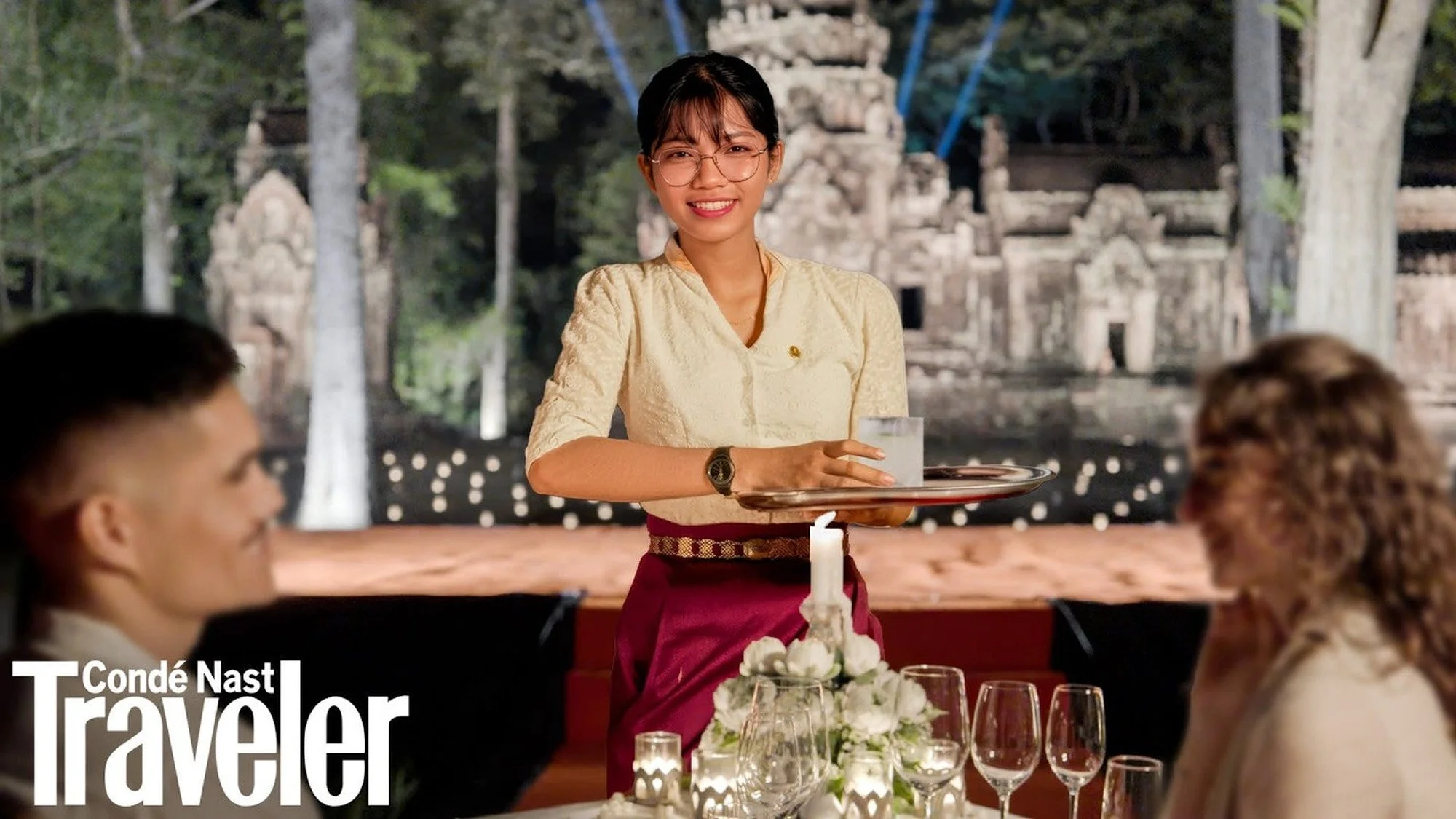
Director of Photography on Condé Nast Traveler's Ask a Local at Raffles Grand Hotel d'Angkor, Siem Reap
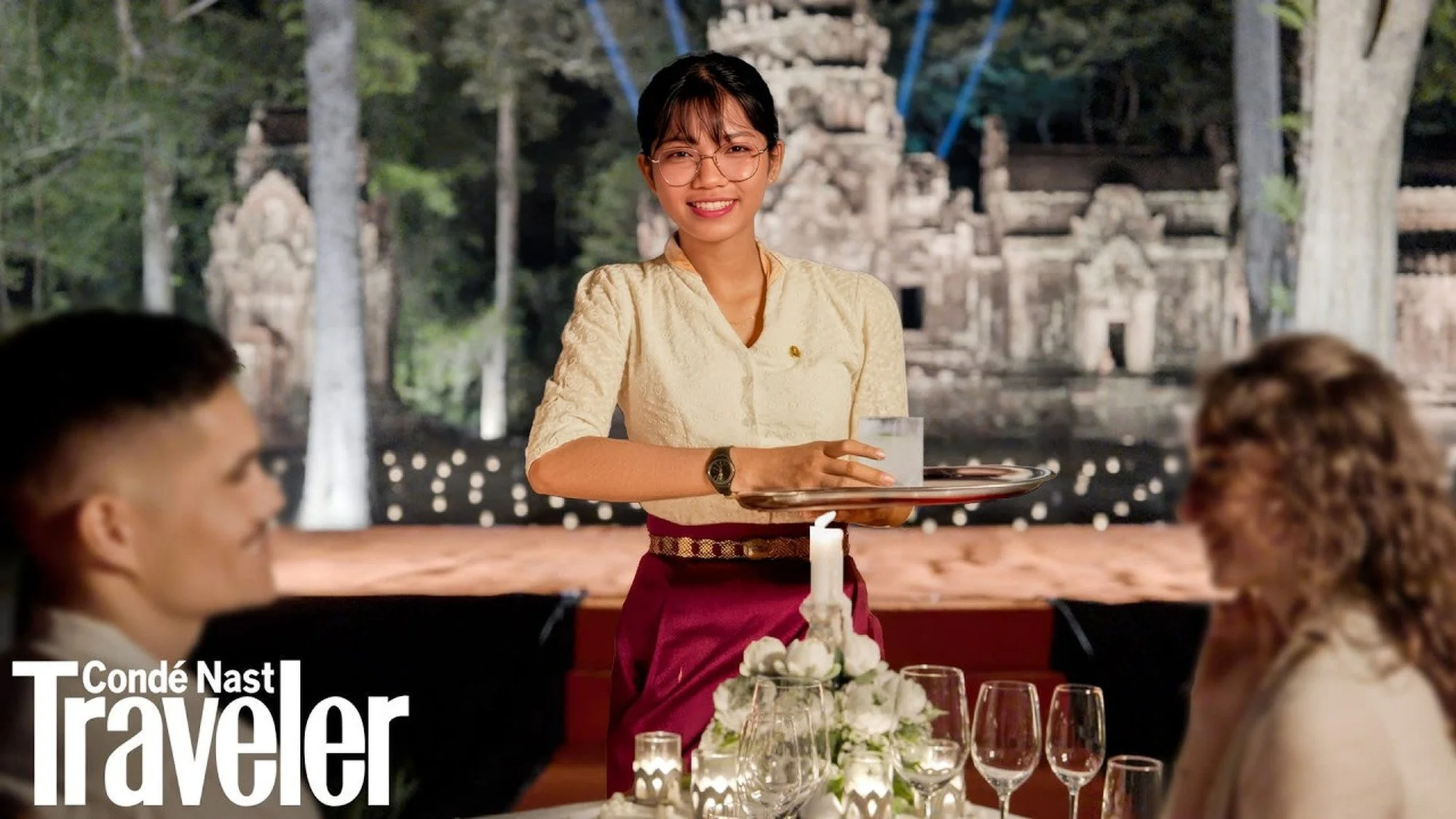
Kakadanisha Chang, Gin Butler at Raffles Grand Hotel d'Angkor, serving a drink at the temple dinner in Angkor for Condé Nast Traveler's Ask a Local, shot by George Jefferies and Kongkea Vann
I was director of photography on Condé Nast Traveler's Ask a Local episode in Siem Reap, filmed in early June. A Day Working at Cambodia's Most Luxurious Hotel follows Kakadanisha Chang, a Gin Butler at Raffles Grand Hotel d'Angkor who calls herself Nisha, from the Old Market in the morning to an evening temple dinner in the Angkor Archaeological Park, with a visit to a gin distillery in between.
We travelled to Siem Reap the morning after we wrapped Where the Chefs Eat in Phnom Penh, which I've written about in a separate post.
Condé Nast Traveler's Ask a Local with Kakadanisha Chang, Gin Butler at Raffles Grand Hotel d'Angkor, Siem Reap. Director of photography: George Jefferies
A new format over two days
Ask a Local was a new format for Condé Nast Traveler, and the production scheduled two days for it. Preshita Saha directed again, and the crew was the same as on Where the Chefs Eat. I was director of photography and A camera operator, Kongkea Vann was on B camera, Sokha Hun recorded sound and Bophay OukChan of Cambodia Film Fixers was our fixer. The production came through Mbrella Films, and Bophay arranged our filming permissions with the Apsara Authority, which manages the Angkor Archaeological Park.
I backed up the cards from Where the Chefs Eat overnight, and we left for Siem Reap in the morning with the same kit: two Sony FX6s with Sony FE 24-105mm f/4 G OSS lenses on Cinesaddles, a Deity TC-1 timecode unit and an Atomos Ninja V monitor on each camera. The camera settings were the same as on Where the Chefs Eat, and at the start of each scene we shot the X-Rite ColorChecker Passport on both cameras, followed by the slate app on my phone, which made it clear to the post-production team where we were filming.
We met the Raffles team when we arrived. That evening we did a recce of the filming locations in the hotel, using the Sun Seeker app, which shows where the sun will be throughout the day.
Early light at Angkor
We opened the day with an early start to get the better light, filming Nisha riding her motorbike through the Angkor Archaeological Park, at the South Gate of Angkor Thom on the road between Angkor Wat and the Bayon. "It makes me so proud to be here," she says about seeing the temples.
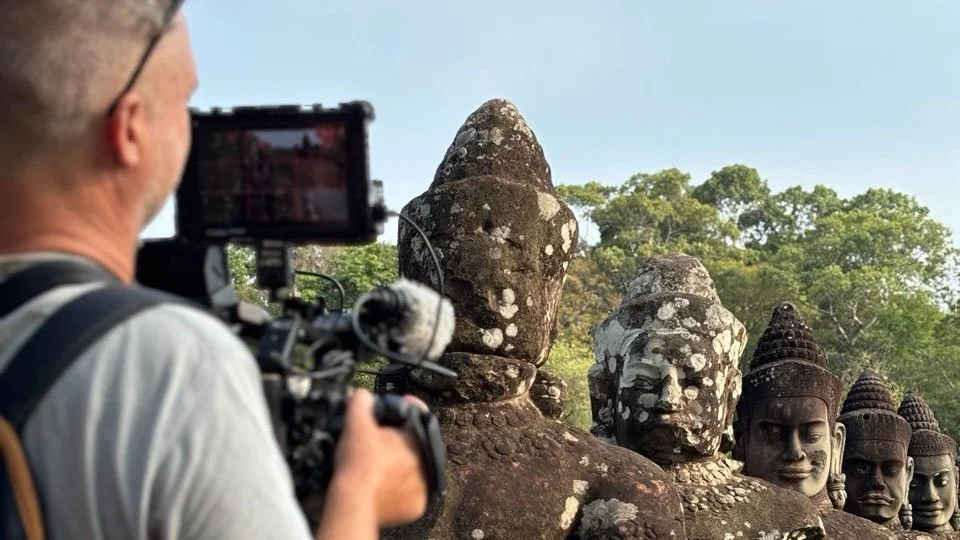
Filming at the South Gate of Angkor Thom for Condé Nast Traveler's Ask a Local
The Old Market and a pagoda
Nisha visits the Old Market to buy ingredients for the bar. "Absolutely anything in this market could be in a cocktail," she says, pointing out rambutan, durian, dragon fruit and pandan. On her way to the hotel she stops at a pagoda to pray before her shift.
A Gin Butler at Raffles
Nisha explains her job in the first minute: "a gin butler is a butler for absolutely anyone who enjoys gin." She goes from guest to guest with a trolley she calls Fernando, and she makes drinks at the hotel's Elephant Bar. We filmed her making the Angkor Amber, a drink she describes as representing Cambodian pride, with the amber standing for the sunrise and sunset at Angkor.
She also visits the Kulen Gin Distillery for inspiration. She describes Cambodian gin as herbal forward, with juniper taking a back seat to the other botanicals.
The temple dinner
The evening is the Raffles Bespoke Temple Dinner at Thommanon Temple, one of the temples in the Angkor Archaeological Park. Before service Nisha lights candles, with over 500 placed around the site, alongside a stage for Apsara dancers, a platform for the guests' dinner, a spot for the musicians and her bar. We filmed the set-up and the service through to her last drink of the night, a non-alcoholic gin gimlet made with ingredients she'd bought at the Old Market earlier in the day.
The episode ends at Calao Bar, a cocktail bar where Nisha unwinds with a friend after her shift.
Handover
I started uploading to the production's cloud storage from Raffles, where the internet was fast and the hotel offered extra bandwidth if I needed it. We travelled back to Phnom Penh the next day and I finished the upload from my office. There were breaks in the upload, so I went through everything with the post-production team to make sure they had all the footage.
The episode was released on Condé Nast Traveler's YouTube channel at the end of October.
You can see more of my work as a director of photography in Cambodia, including a BBC Travel Show segment at Angkor, where I was shooting producer, director and camera operator. Based in Phnom Penh and available for assignments across Southeast Asia. Drop me a line to discuss your project.
Flying Drones in Cambodia: Permissions, Experience and What You Need to Know
I’ve been working as a drone operator in Cambodia since shortly after DJI launched the original Phantom in 2013. This post covers getting permission to fly in Phnom Penh and at the Angkor Archaeological Park.
Drone showreel, aerial videography across Cambodia
I've been working as a drone operator in Cambodia since shortly after DJI launched the original Phantom in 2013. Since then I've flown the Phantom 2, 3, 4 and 4 Pro, the Mavic Pro, Mavic Pro 2, Mini 3 Pro, and now the DJI Air 3. I've used drones on productions ranging from NGO field work and corporate videos to broadcast documentary and feature film. The progress in that time has been remarkable, with the introduction of dual lenses, omnidirectional obstacle sensing, extended battery life, and stabilisation that makes aerial footage possible in conditions where earlier models simply couldn't fly.
This post covers the two locations where you'll definitely be asked for permission, Phnom Penh and the Angkor Archaeological Park, along with some notes on indoor flying, drone photography, and some highlights of my drone flying in Cambodia.
Flying in Phnom Penh
For television and documentary productions, the permissions process in Phnom Penh is a two-stage process. You apply first to the Ministry of Information, which processes the permit. You then take that letter to City Hall, where they countersign and confirm that you have approval to fly within the capital. If you're making a feature film, the Ministry of Culture and Fine Arts is the relevant authority.
When I was flying for CNN's Nomad with Carlton McCoy, the local fixer gave me a copy of the permission letter, which was a good idea. Every time I took off, a security guard arrived and asked to see the permission. You will be asked to show your paperwork when openly flying in central Phnom Penh, so make sure you have it.
People have been detained for flying in restricted areas, and some incidents are well known in the production community here. For professional work in Phnom Penh, obtaining permission before you fly is not optional.
At the time of writing, there is a blanket ban on drone flights across Cambodia as a result of the Thailand-Cambodia border situation. Permissions are still being granted for the right projects, but this is worth factoring into your planning if you're scheduling a drone shoot in the near future.
Flying at the Angkor Archaeological Park
Angkor operates through the Apsara Authority, the body responsible for managing the archaeological park. You apply in writing and the process typically takes between two weeks and a month. The Apsara Authority will confirm whether permission is granted and advise on the fee, which is set case by case rather than at a fixed rate.
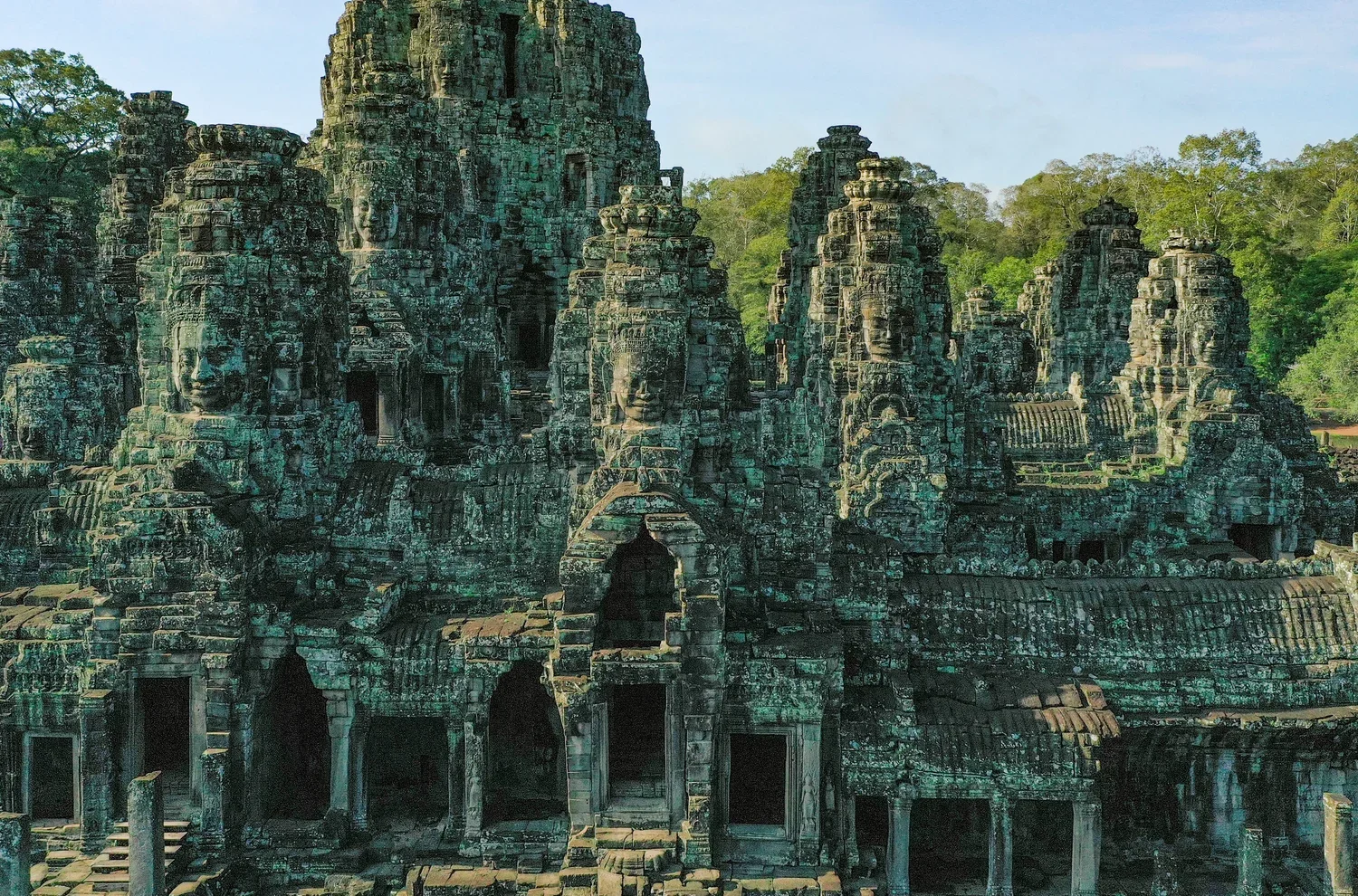
I've been lucky enough to fly my drone at the temples twice. The first was for Taste of Cambodia, a travel series for the Cambodia Ministry of Tourism produced with Hanuman Films, where I had a three-day permit covering Angkor Wat, Angkor Thom and Ta Prohm, the temple featured in Tomb Raider. The second was for CNN's Nomad with Carlton McCoy, shooting at Angkor Wat.
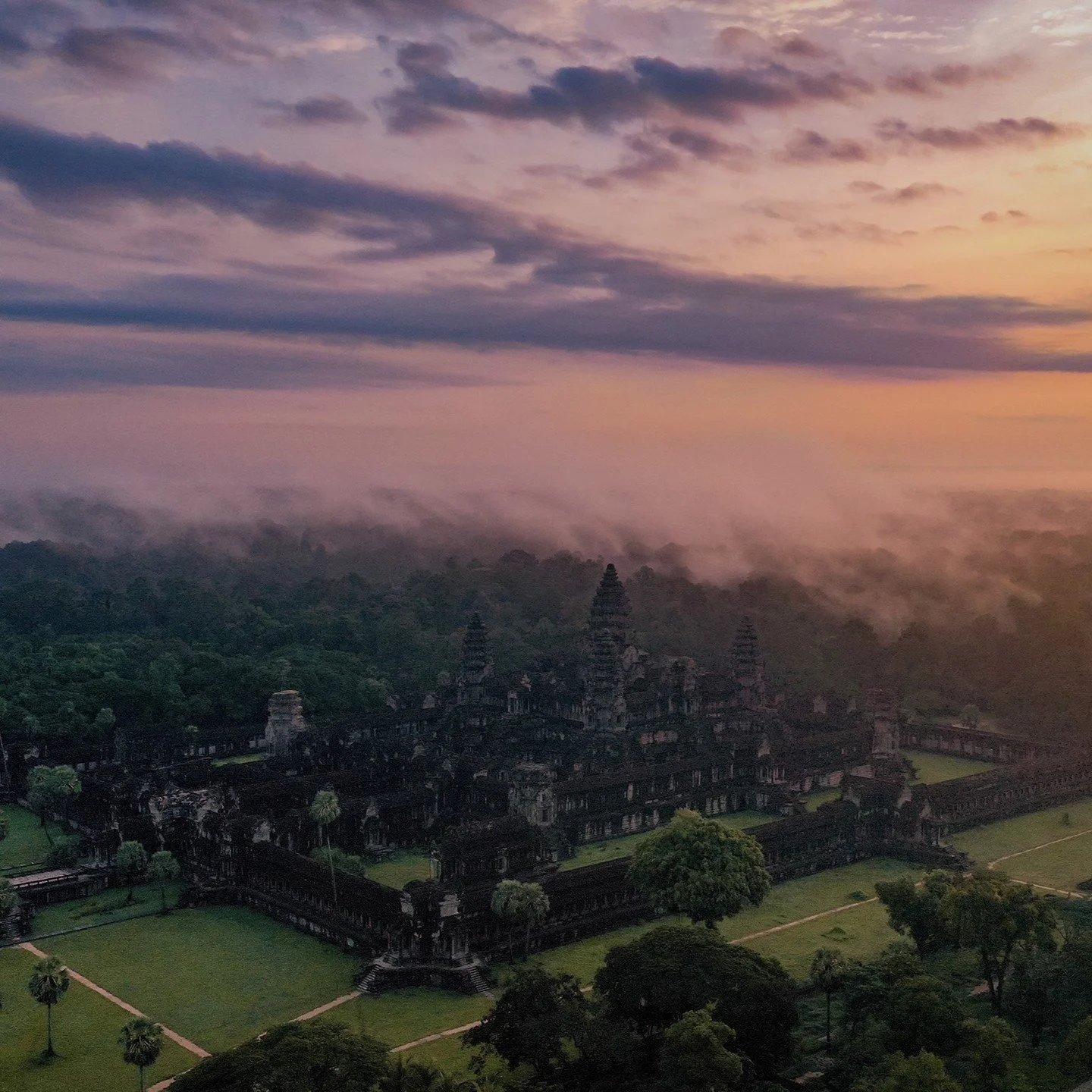
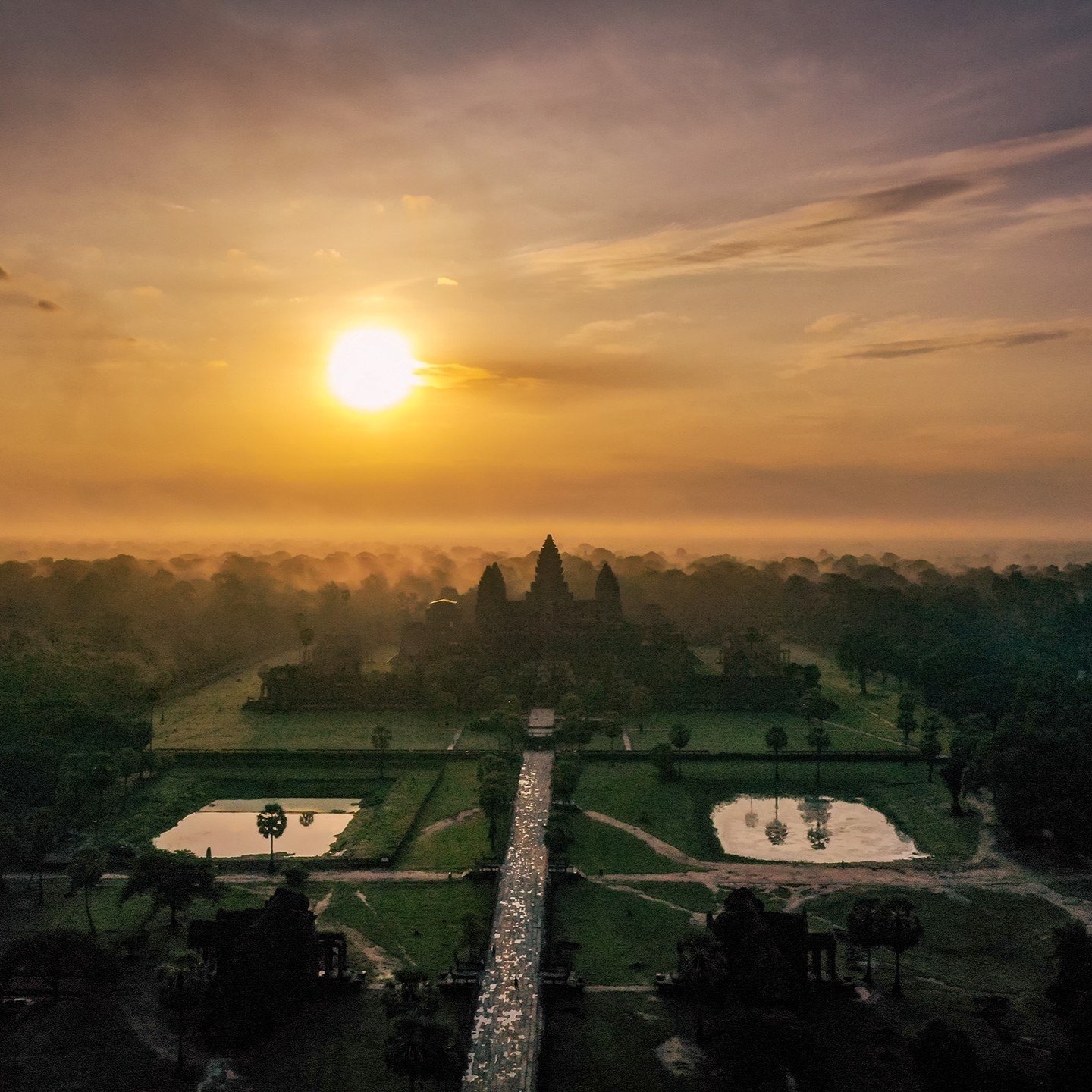
I was up before sunrise on the first two mornings of the Taste of Cambodia shoot at Angkor Wat, waiting for light that never came through the cloud. On the third morning it had rained overnight and, as the sun rose, mist lifted from the stone path leading up to the temple and the surrounding jungle. The footage from that morning made up for the earlier disappointments, and it's the kind of image that's only available if you have the right permissions and the patience to wait for the conditions to arrive.
Indoor Drone Work
Part of the drone work I do has been flying inside buildings, which is a different discipline from outdoor flying and one that demands a drone with reliable obstacle sensing.
For a corporate film for Endo Lighting, I flew inside AEON 3 Mall in Phnom Penh to capture their lighting installation. Flying up through the full height of the central atrium and along the skywalk, a key part of the design they wanted to show, gave the client footage that couldn't have been achieved any other way. You can see the video here.
For a video produced with Pixel Peers for the ILO's Better Factories project, I flew inside a garment factory in Kandal Province on the outskirts of Phnom Penh, documenting the manufacturing environment as part of their Better Factories programme.
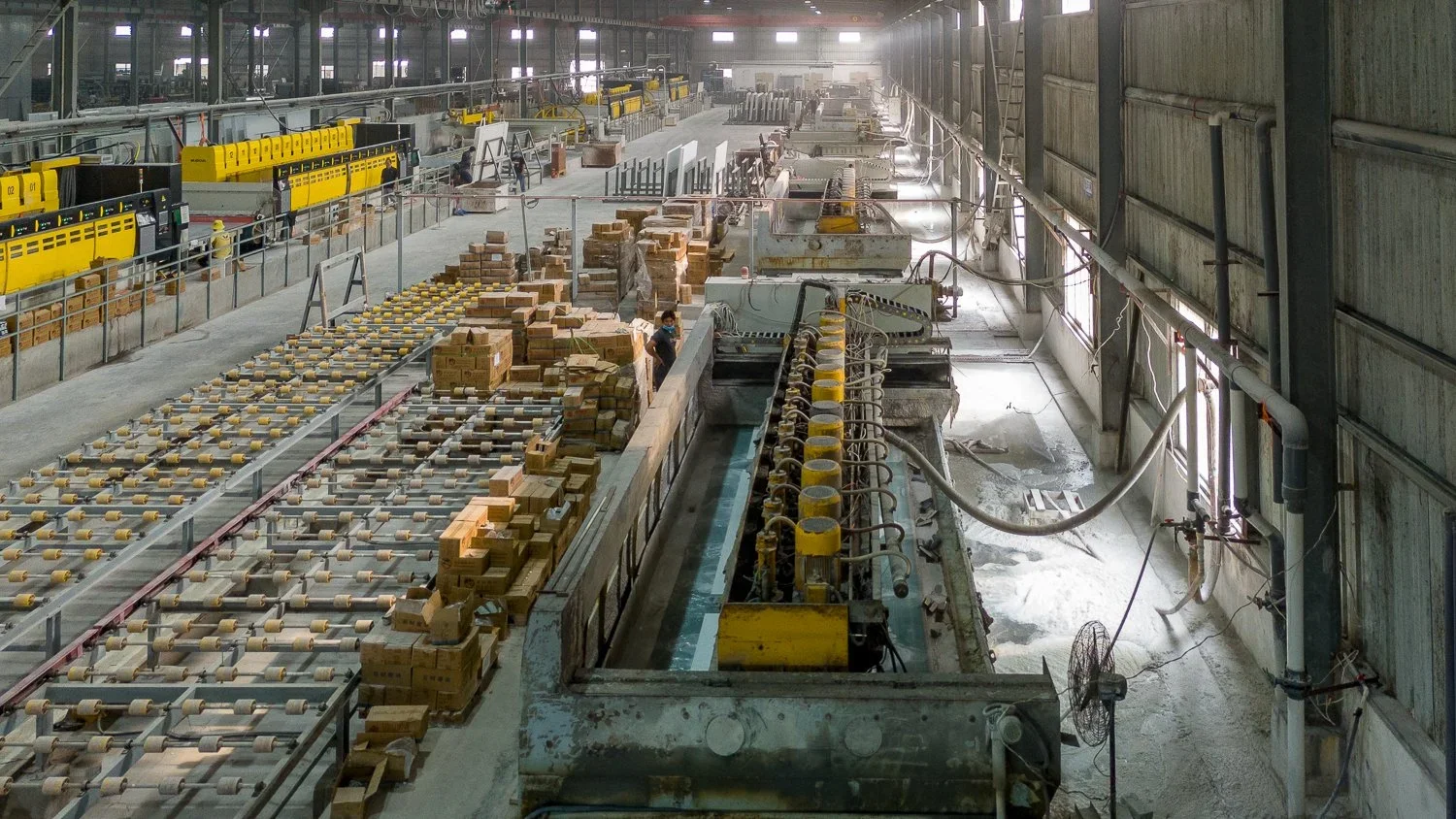
I also flew inside Cambodia Zulite Stone's quartz manufacturing facility for a corporate film delivered for exhibition at a trade show in New York. The DJI Air 3's omnidirectional obstacle sensing makes it well suited to indoor work of this kind.
On a number of shoots, drone photography has been delivered alongside the video. The Air 3 and many other DJI drones make switching between modes straightforward. You press the left-hand shoulder button and it switches between photography and video. Once the settings for both are configured, it's easy to switch at the click of a button, and then another click either takes a photo or starts recording. Stills and video can be captured in the same session without significantly disrupting the shooting workflow. Both Endo Lighting and Cambodia Zulite Stone received drone photography deliverables alongside their films. Drone stills are something I can offer alongside videography on most shoots.
Flying Across Cambodia
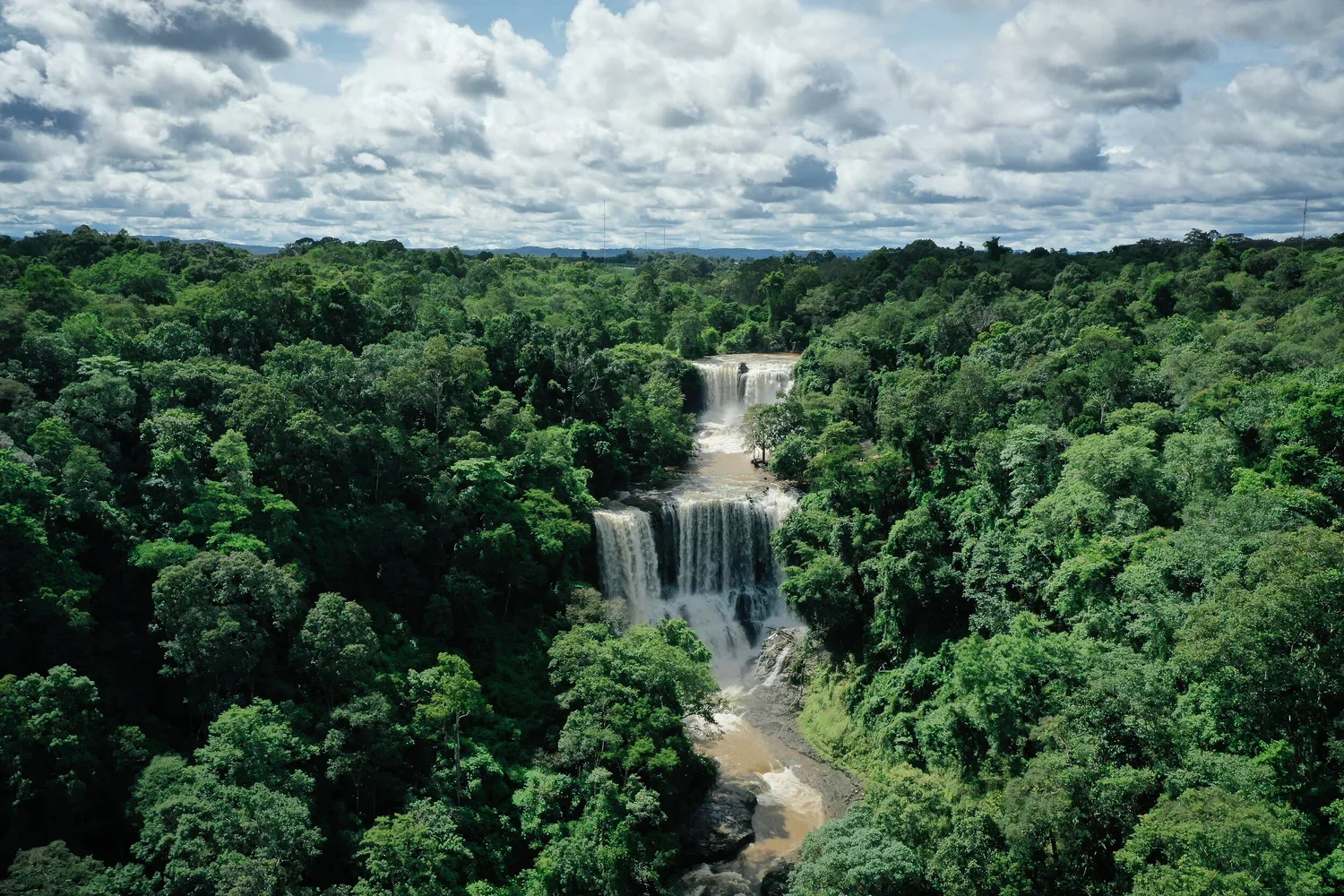
Across Cambodia as well as Phnom Penh and Angkor, I've flown for a wide range of productions. Locations include Kampot and Kep on the coast, the highlands of Mondulkiri, Kratie, Stung Treng, Battambang and Kandal Province. Outside the capital and the archaeological park, enforcement is lighter and I've never been stopped when flying recreationally, though technically a local authority approval from the relevant sangkat is required alongside the Ministry of Information permit for professional productions.
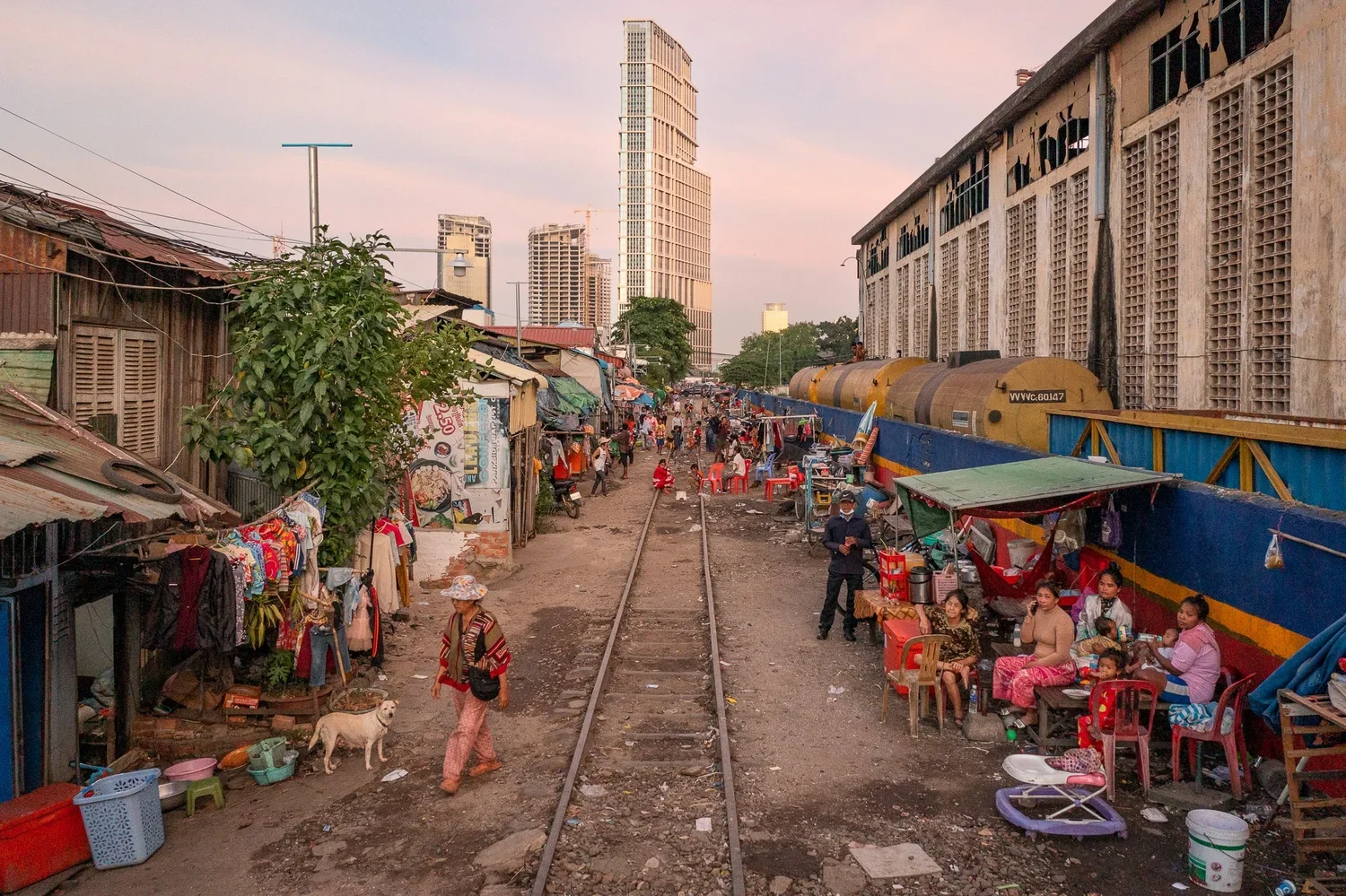
Productions involving significant drone work include a 46-minute documentary for CNA Insider on the Funan Techo Canal, where I flew over the Mekong River, Battambang's rice paddies and the Phnom Penh Autonomous Port, and the Taste of Cambodia series for the Ministry of Tourism. For the CNN shoot I flew Central Market, Wat Phnom, Vattanac Tower, the CBD and the Angkor temples. For Wild Frontiers, one of the UK's leading adventure travel companies, I flew across India, Ukraine and Moldova. You can see a selection of that aerial work in my drone reel for Khreativa.
Cambodia as a Production Destination
The Cambodia Tourism Board recently launched a Location Scouting Programme designed to support international film, television, documentary and commercial productions. The programme covers up to five days of on-ground expenses during location scouting, including accommodation, local transport, fixer or guide services, and entry fees for national parks and heritage sites. Flights are not covered, but it's an encouraging development that reflects a genuine effort by the Cambodian government to attract international productions to the country.
Kit
My current drone is the DJI Air 3, with 28mm and 70mm lenses and omnidirectional obstacle sensing, suitable for both indoor and outdoor work. Additional drones are available to hire for productions requiring different specifications. Full production kit, including lighting, sound and grip, is available alongside drone services.
You can see more of my drone work on the drone operator page, and further examples across the corporateand documentary portfolio pages.
If you have questions about flying drones in Cambodia, whether for a production you're planning or just to understand the permissions process, feel free to get in touch. Based in Phnom Penh and available for assignments across Southeast Asia.