
Working as Director of Photography on a CNA Insider Documentary About the Funan Techo Canal
At the end of last year I was brought in as director of photography on a 46-minute documentary for CNA Insider, the long-form current affairs strand of Channel NewsAsia.
At the end of last year I was brought in as director of photography on a 46-minute documentary for CNA Insider, the long-form current affairs strand of Channel NewsAsia. The film, Cambodia’s Mega Canal Has Vietnam Worried: What Does It Mean for the Mekong?, examines the Funan Techo Canal, a 180km waterway that will connect the Mekong River to the Gulf of Thailand, and the regional tensions it has stirred, particularly with Vietnam. It was produced by Loy Kheng Wee and executive produced by Daniel Heng, both of whom were in the field with me throughout the shoot. Daniel is an experienced hand with a deep knowledge of Southeast Asia and the Insight series.
It was a five-day shoot across multiple locations in Cambodia: Phnom Penh, the groundbreaking site of where the canal will be built, Battambang, and the Phnom Penh Autonomous Port. Over the course of the week we filmed more than ten interviews, and during interviews I operated two cameras to give the editor a choice of angles.
46-minute CNA Insider documentary on the Funan Techo Canal, Cambodia, director of photography: George Jefferies
The Technical Setup
It was a multicam shoot. During interviews, I worked with a Sony FX6 and Sony A7S III, with the FX6 as the wider master and the A7S III as the closer camera. I also mounted the A7S III on a gimbal, giving different shooting options at all points and allowing me to move quickly and efficiently between handheld, gimbal, and tripod as each situation required. Sound was recorded both on a boom mic and a concealed lav mic, which gave us clean options in post regardless of the environment.
Drone work was also part of the brief. The local fixer obtained the necessary permissions to fly in Phnom Penh, and I flew the DJI Air 3 across several locations: the Mekong River, the Cambodian-Japanese friendship bridge crossing the Tonle Sap, rice paddies and a rice processing facility in Battambang, the Koh Pich area of Phnom Penh, and the Phnom Penh Autonomous Port where cargo boats currently make the journey down the Mekong through Vietnam. That footage was particularly relevant to the story, as those are the boats that would eventually use the canal rather than the Vietnamese route.
Interviews and Locations
The range of interview subjects gave the film its shape. In Phnom Penh we filmed with Chea Thyrith, spokesperson for the CPP, along with a range of experts offering analysis of the canal’s economic and geopolitical implications. At the groundbreaking site we spoke with a number of local residents living in the path of the canal. They knew little about what relocation would mean for them, as compensation, timing, and next steps were all still unclear, largely because the project itself had yet to move beyond its early stages. At the Port Authority building we interviewed a representative about the commercial case for the canal. In Battambang, we filmed with a rice factory owner who currently exports through Cambodia having previously relied on Vietnamese ports, and shot in the rice paddies where the crop is grown.
Lighting and operating across that many locations over five days, with two cameras, is a logistical undertaking. Each location brings its own challenges: ambient light direction, background management, the fast pace at which a documentary crew moves. Getting consistent, broadcast-quality results across all of them is the job.
The Story Itself
The Funan Techo Canal is a project that raises significant questions. Cambodia argues the canal will reduce its reliance on Vietnamese ports, through which roughly a third of its global cargo currently passes. Vietnam, meanwhile, is concerned about the canal’s potential to divert water flows from the Mekong Delta, a river system already under pressure from upstream dams and climate change. There are also questions about whether the waterway could serve Chinese military purposes, though experts note it will not be deep enough to accommodate naval vessels.
When we were shooting, there was genuine uncertainty about the project’s timeline and funding. People we spoke to were largely supportive of the idea, but specifics were hard to come by. Since filming, a financing deal between Cambodia and China has been finalised, which gives the project more concrete footing, though whether it meets its 2028 completion target remains to be seen.
Working with the Production Team
It was good to work alongside Daniel Heng, whose knowledge of the region showed throughout the shoot. I also worked with producer Loy Kheng Wee, for whom this was her first shoot in the field as a producer. I hope it was a useful experience and that she has gone on to make many more interesting documentaries.
CNA Insider has been one of the more consistent commissioners of serious, long-form journalism in Southeast Asia. Working on a documentary of this scale and complexity, covering a story with genuine regional significance, was a good addition to the slate.
Working on something similar? Drop me a line, I’d be happy to discuss how I can help.
Capturing Commercial Drone Photography for Cambodain Zulite Stone


Panmin had a been in touch about about a corporate video and requested additional drone photographs for use on their website, print materials and at trade fairs.
I had recently bought a DJI Air 3 as I’d had a job that required indoor drone videography and photography and I’d hired a DJI Mini 3 Pro. With improved vision sensors and technology, the Air 3 was the ideal tool for the job.
The improved battery life enabled me to fly for extended periods while capturing all aspects of quartz processing.
While the 28mm lens was great at showing the scale of the factory, the new 70mm lens allowed me to punch in and use the drone for dolly shots to get in close and to highlight the key details of the process.
With the combination of sensor size, sensoring technology and dual lenses the Air 3 was the ideal tool for the job.
I also managed to capture a series of exteriors showing both the facitliy and the industrial park.
The client were happy with the result and have used the photos extensively on their website
You can see more examples of my drone photography here and here.
Corporate Videography Shoot for Cambodia Zulite Stone
I was contacted through my website to make a corporate video for Cambodia Zulite Stone Co. LTD. Their parent company was attending a trade show in New York, so they needed a corporate videographer to deliver a video they could show at the trade show to showcase the quartz products they make in their factory.
Despite the language barrier, the process was easy. They sent sample videos they’d shot and we communicated about the key aspects of the product and the key aspects of the process they wanted included.
I then travelled to their location and spent the afternoon recceing the factory before shooting the next morning.
A key aspect of what they wanted to show was the scale and capacity of their operation. Due to its omnidirectional vision system and a three-dimensional infrared sensing system my newly acquired DJI Air 3 was the ideal tool for flying inside their factory.
I also shot close ups on tripod to highlight the details and precision of the key parts of the process.
The edit was a smooth process. I quickly turned around 1st and 2nd edits and after receiving feedback, I made some final tweaks so the video was ready to present at the exhibition in New York.
The management at the factory were keen to show the favourable working conditions they’d created for their staff. The staff are given 3 square meals a day and are provided with accommodation as part of their contract. This allows them to save more money.
You can see more examples of my corporate videos here and here.
On Location - Taking Commercial Drone Interior and Exterior Photos for Endo Lighting


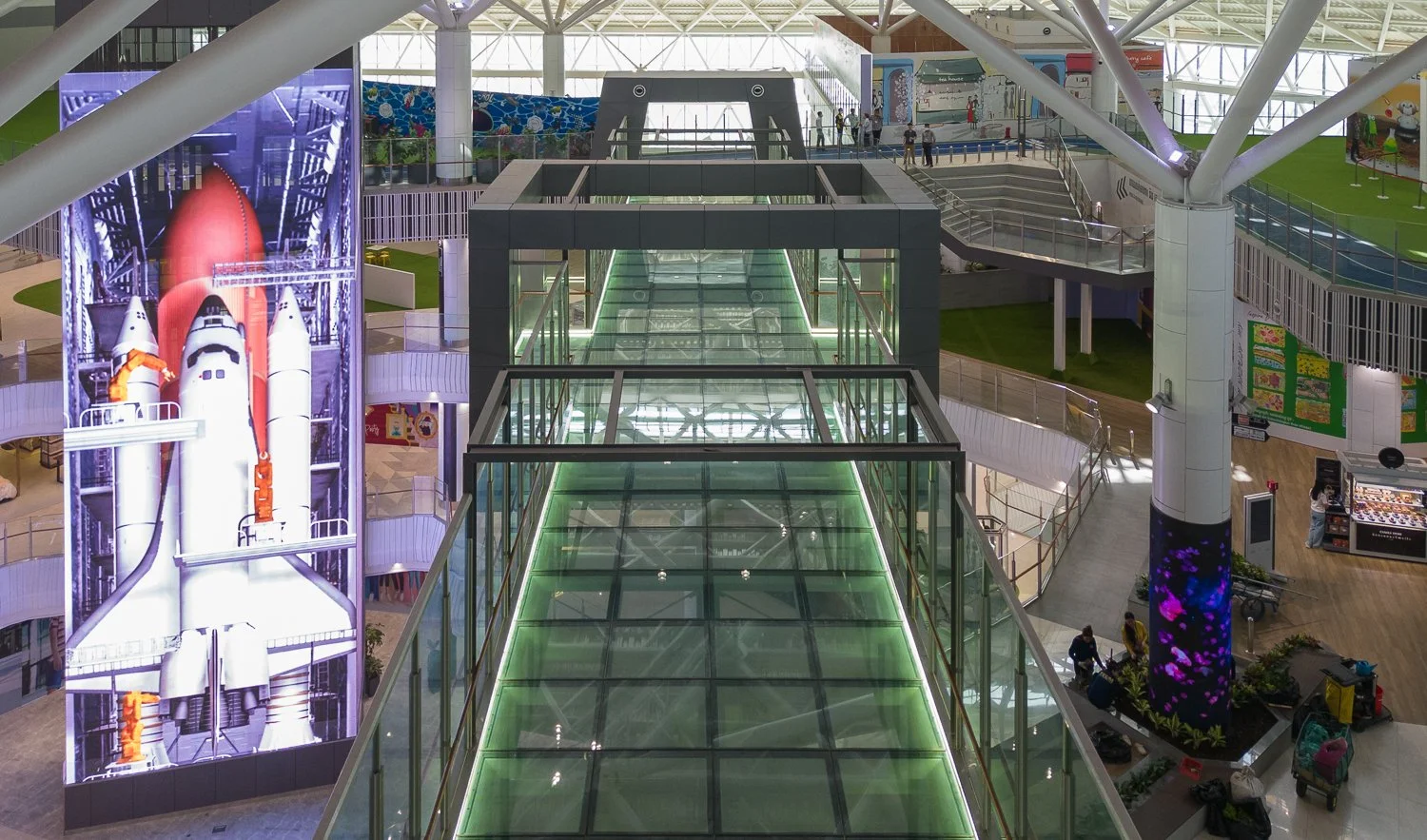
During pre-production on a corporate video for Endo Lighting to show their lighting installation at AEON 3, the client requested some drone photography to use on their website.
While Simon Toffanello was doing the photography for them, it made sense for me to take the drone photographs as I would be operating a drone for video I was shooting.
Endo Lighting requested a series of exterior and interior drone shots to show the building and their lighting installation.
The exterior drone photographs were taken with a Mavic 2 Pro. They were taken at dusk so the photo gives the impression of it being dark will retaining detail in the background and reducing the noise due to there still being a bit of ambient light.
Due to the height restriction on the Mavic 2 Pro, I hired a Mini 3 Pro, which is a lighter drone that is better designed to fly indoors.
You can see the corporate corporate video I made for them here and check out other examples of my drone photography here. As predominantly a videographer, I mainly use the drone to shoot video and take photographs as an afterthought. It would be great to make more of an effort to explore the creative potential of drone photography.
On Location - Filming a Corporate Video for Endo Lighting
It was great to team up with Khreativa Cambodia to work on a corporate video for Endo Lighting to showcase their lighting installations at the newly opened AEON 3 Mall in Phnom Penh.
Endo Lighting commissioned Khreativa Cambodia to provide a series of photos and a video and I was fortunate to be given the lead on the video production.
After a pre-production meeting and looking at the sample videos provided by the client, we decided on the techniques and equipment that we would use to capture the feeling of entering the mall and experiencing the different moods created by the coloured lighting throughout the day.
For the exteriors, I used my DJI Mavic 2 Pro due to its low-light capabilities, as some of the shots were taken at dusk, and stability in wind.
The client also wanted interior drone shots to show the Skywalk and to fly up the central atrium to show the different lighting atmospheres they created on different levels.
As the Mavic 2 has height restrictions when it can’t use enough GPS satellites, we had to hire a Mini 3 Pro to be able to capture the interior drone shots.
For the ground shots, I used a gimbal at eye level and a gimbal mounted on a boom to capture higher shots for a different perspective. A wireless transmitter was mounted to the set up so that we could monitor the feed and an assistant could remotely control tilts to add dynamism.
Endo Lighting were very happy with the video and even entered it into a corporate video competition!
You can see other examples of my corporate videos here and here.